
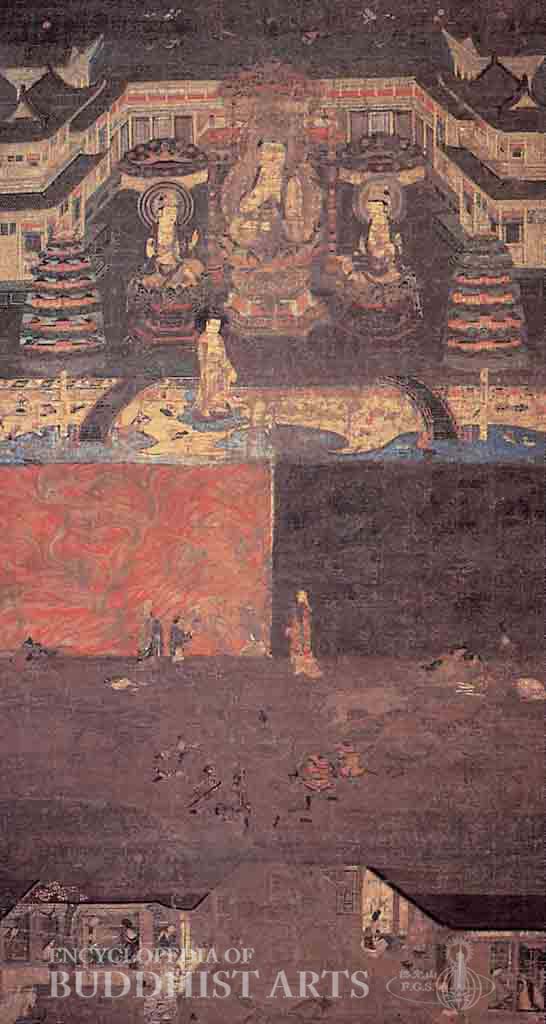
Komyoji Temple: Parable of the Two Rivers
Ink and color on silk
二河白道圖
日本
此圖將中國唐代(618~907)僧人善導著《觀無量壽經疏》〈善散義〉所述的二河譬喻,加以圖像化。繪製於十三世紀。一九○七年指定為日本重要文化財。
圖上部為阿彌陀佛三尊及極樂淨土。圖中央代表貪愛及瞋恚的水河和火河橫向流淌,其間細白道直通極樂淨土。二河下描繪傍著財寶的家族與戰爭的武士,表現貪愛和瞋憎。一人立於白道入口,受佛鼓勵往白道前進。圖下有正在飲食和管弦演奏之邸館,表現如現世的火宅,館間繪馬匹,意味著煩惱和放逸。
作品採遠近景構圖,布局對稱,用筆精細,人物偏小,予人深遠空曠之感。
For more details, go to the Encyclopedia of Buddhist Arts: Painting I-O, page 447.
Cite this article:
Hsingyun, et al. "Komyoji Temple: Parable of the Two Rivers." Encyclopedia of Buddhist Arts: Painting I-O, vol. 15, 2016, pp. 447.
Hsingyun, Youheng, Youlu, Graham Wilson, Manho, Mankuang, and Susan Huntington. 2016. "Komyoji Temple: Parable of the Two Rivers" In Encyclopedia of Buddhist Arts: Painting I-O, 15:447.
Hsingyun, Youheng, Youlu, Wilson, G., Manho, Mankuang, & Huntington, S.. (2016). Komyoji Temple: Parable of the Two Rivers. In Encyclopedia of Buddhist Arts: Painting I-O (Vol. 15, pp. 447).
@misc{Hsingyun2016,
author = Hsingyun and Youheng and Youlu and Wilson, Graham and Manho and Mankuang and Huntington, Susan,
booktitle = {Encyclopedia of Buddhist Arts: Painting I-O},
pages = 447,
title = {{Komyoji Temple: Parable of the Two Rivers}},
volume = 15,
year = {2016}}
author = Hsingyun and Youheng and Youlu and Wilson, Graham and Manho and Mankuang and Huntington, Susan,
booktitle = {Encyclopedia of Buddhist Arts: Painting I-O},
pages = 447,
title = {{Komyoji Temple: Parable of the Two Rivers}},
volume = 15,
year = {2016}}