
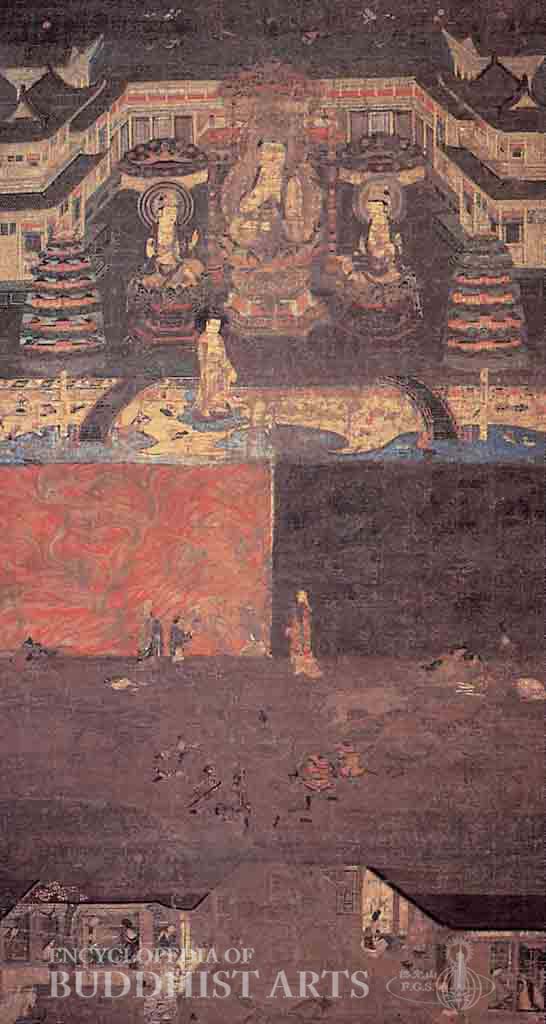
Komyoji Temple: Parable of the Two Rivers
Ink and color on silk
Komyoji Temple: Parable of the Two Rivers
JAPAN, Kyoto, Nagaokakyo; Kamakura period
This 13th century painting of the Parable of the Two Rivers was listed as an Important Cultural Property in 1907. The parable, based on a story in the Commentary on the Amitayurdhyana Sutra by Master Shandao, a Chinese monk of the Tang dynasty (618–907), is an allegory for the path to rebirth in the Western Pure Land amid the obstructions of greed and anger. Large numbers of paintings depicting the parable were produced by various factions of the Pure Land school after it was mentioned in the Original Vow by Honen, the founder of the school. The parable tells of a traveler pursued by bandits and vicious beasts in a wilderness. The traveler flees toward the west and discovers a very narrow white bridge that separates two rivers: the river of fire, which flows south and represents anger, and the river of water, which flows north and represents greed. Each river is a hundred paces wide and infinitely long. The bridge provides a means to cross over to the opposite west bank but is constantly deluged by waves from the river of water and flames from the river of anger. The traveler wavers when the voice of temptation on the east bank urges him not to cross. From the west bank, a voice calls on him to move forward, assuring him that the bridge can be crossed. The traveler ignores the voice of temptation and crosses safely to the west bank, where he is met with boundless joy by virtuous friends.
The painting’s upper register portrays the Amitabha Buddha triad in the Western Pure Land. In the middle register, two rivers flow horizontally. The narrow white bridge separating the two rivers represents the way to the Western Pure Land. In the lower register, there are depictions of a clan with treasures and warriors in battle, which symbolize greed and anger respectively. A man stands at the foot of the white bridge. The small figures give a sense of vast space to the painting.
For more details, go to the Encyclopedia of Buddhist Arts: Painting I-O, page 447.
Cite this article:
author = Hsingyun and Youheng and Youlu and Wilson, Graham and Manho and Mankuang and Huntington, Susan,
booktitle = {Encyclopedia of Buddhist Arts: Painting I-O},
pages = 447,
title = {{Komyoji Temple: Parable of the Two Rivers}},
volume = 15,
year = {2016}}