
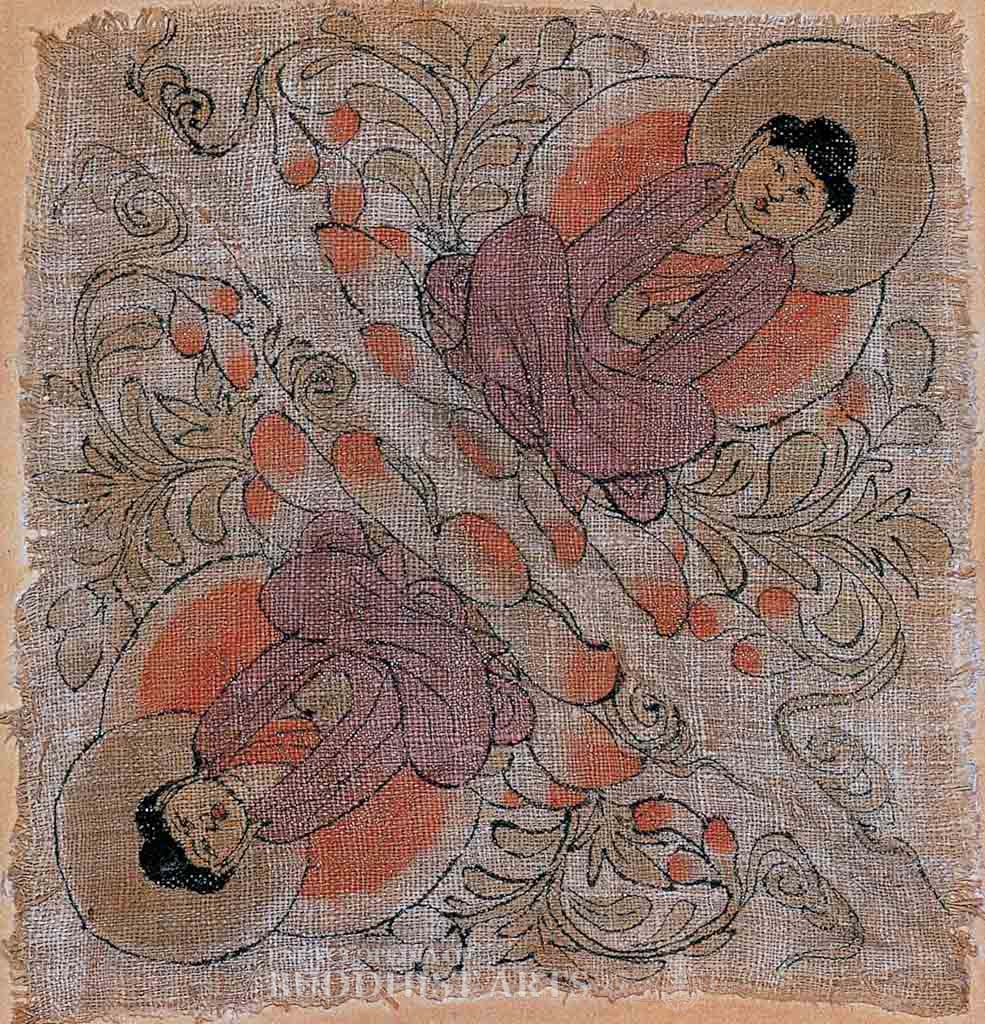
Mogao Cave 17: Seated Buddha
Ink and color on linen
佛坐像
甘肅省酒泉市敦煌市莫高窟第17窟出土
甘肅省酒泉市敦煌市莫高窟第17窟出土。此麻布每平方公分的經、緯各有十一條麻線,是一件繪製於十世紀下半葉的作品。
近乎正方形的麻布上繪二坐佛,相對而坐,穿著、姿態及蓮座旁延伸的蔓草均一致,用色亦同。麻布依對角線分為兩半,成為相等的三角形,兩面均能見到佛像,作為幡頭之用。
幡,原為古印度武士用於戰場上,以統領軍旅、顯揚軍威之物,佛教則用以彰顯佛菩薩降魔之威德。造幡有降魔、延壽等種種福德。
造幡功德於《撰集百緣經》卷七〈布施佛幡緣〉有所記載,波多迦初生之時,有大幡蓋覆蓋全城。一日他於尼拘陀樹下見佛相好莊嚴,遂聽佛說法,心有所悟,便請求出家,後因精進修習,得阿羅漢果。眾人見之,皆問佛曰,波多迦比丘以何種福德因緣,出家得道。
佛告訴大眾,於過去九十一劫,有一王建造四寶塔,供養舍利。當時有一人發願造長幡,懸掛於塔上,此人即是波多迦比丘。因此造幡功德,於九十一劫不墮三惡道,常有幡蓋覆於其上。
For more details, go to the Encyclopedia of Buddhist Arts: Painting I-O, page 654.
Cite this article:
Hsingyun, et al. "Mogao Cave 17: Seated Buddha." Encyclopedia of Buddhist Arts: Painting I-O, vol. 15, 2016, pp. 654.
Hsingyun, Youheng, Youlu, Graham Wilson, Manho, Mankuang, and Susan Huntington. 2016. "Mogao Cave 17: Seated Buddha" In Encyclopedia of Buddhist Arts: Painting I-O, 15:654.
Hsingyun, Youheng, Youlu, Wilson, G., Manho, Mankuang, & Huntington, S.. (2016). Mogao Cave 17: Seated Buddha. In Encyclopedia of Buddhist Arts: Painting I-O (Vol. 15, pp. 654).
@misc{Hsingyun2016,
author = Hsingyun and Youheng and Youlu and Wilson, Graham and Manho and Mankuang and Huntington, Susan,
booktitle = {Encyclopedia of Buddhist Arts: Painting I-O},
pages = 654,
title = {{Mogao Cave 17: Seated Buddha}},
volume = 15,
year = {2016}}
author = Hsingyun and Youheng and Youlu and Wilson, Graham and Manho and Mankuang and Huntington, Susan,
booktitle = {Encyclopedia of Buddhist Arts: Painting I-O},
pages = 654,
title = {{Mogao Cave 17: Seated Buddha}},
volume = 15,
year = {2016}}