
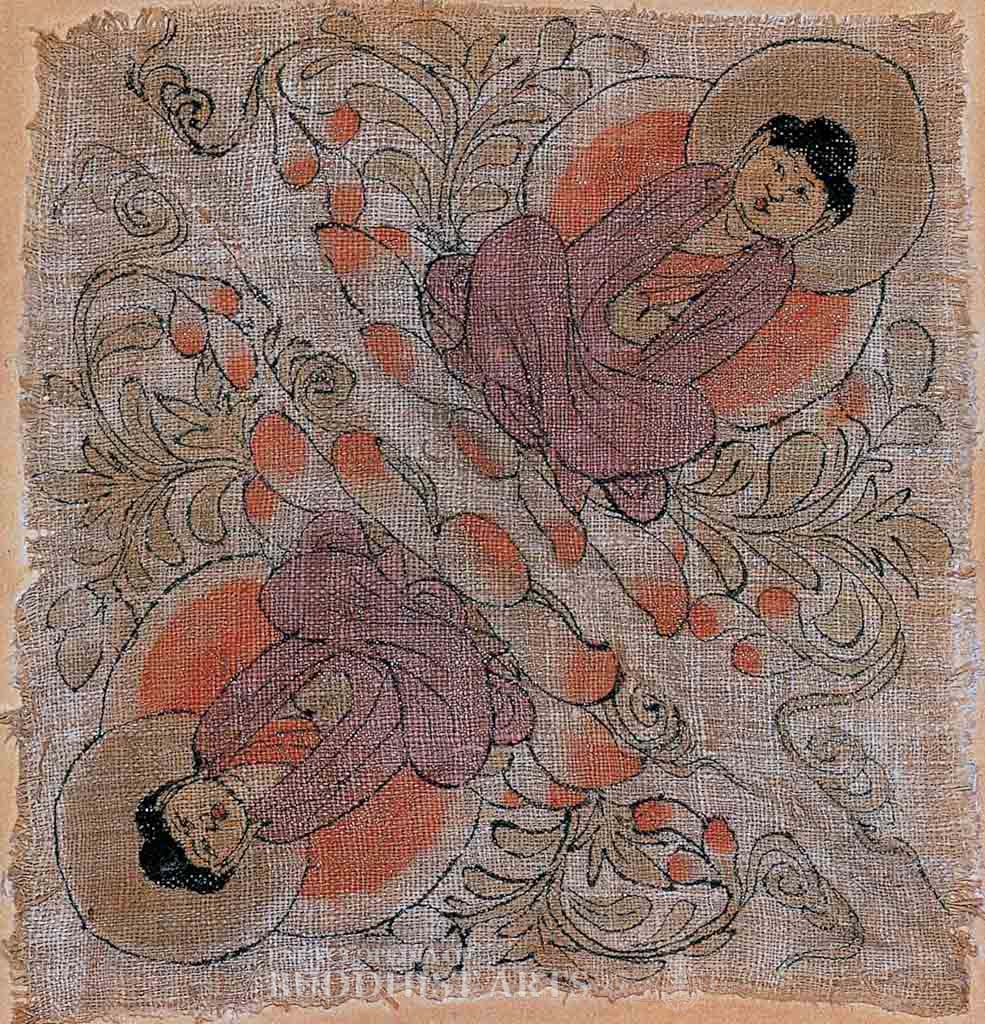
Mogao Cave 17: Seated Buddha
Ink and color on linen
Mogao Cave 17: Seated Buddha
CHINA, Gansu, Dunhuang; Northern Song dynasty
This 10th century illustration was painted on linen. The square cloth is split along a diagonal axis and depicts two similar Buddha figures wearing purple monastic robes and sitting on lotus thrones. It was likely meant to be folded along the axis and used as the headpiece of a banner.
Banners were originally used on battlefields in ancient India to indicate leadership and communicate orders. The banner was adopted by Buddhism to symbolize the victories of the Buddhas and Bodhisattvas over Mara. Those who make banners are said to accumulate great merit, and are protected from evil and have their lives prolonged. Such merits are described in the “Offering Banners to the Buddha” section of the Avadanasataka, which tells the story of the Arhat, Pataka. On one occasion, he chanced upon the Buddha under the Nyagrodha tree, and after listening to the Buddha teach the Dharma, instantly understood and asked to be tonsured. With diligent effort, he became an Arhat. People who witnessed it asked the Buddha how Pataka had achieved this. The Buddha explained that 91 kalpas ago, there was a king who built a pagoda to house relics. At that time, Pataka resolved to make a long banner and hang it on the pagoda. The merits accumulated from making the banner spared him from rebirth in the three lower realms and facilitated his attainment of Arhatship.
For more details, go to the Encyclopedia of Buddhist Arts: Painting I-O, page 654.
Cite this article:
author = Hsingyun and Youheng and Youlu and Wilson, Graham and Manho and Mankuang and Huntington, Susan,
booktitle = {Encyclopedia of Buddhist Arts: Painting I-O},
pages = 654,
title = {{Mogao Cave 17: Seated Buddha}},
volume = 15,
year = {2016}}