
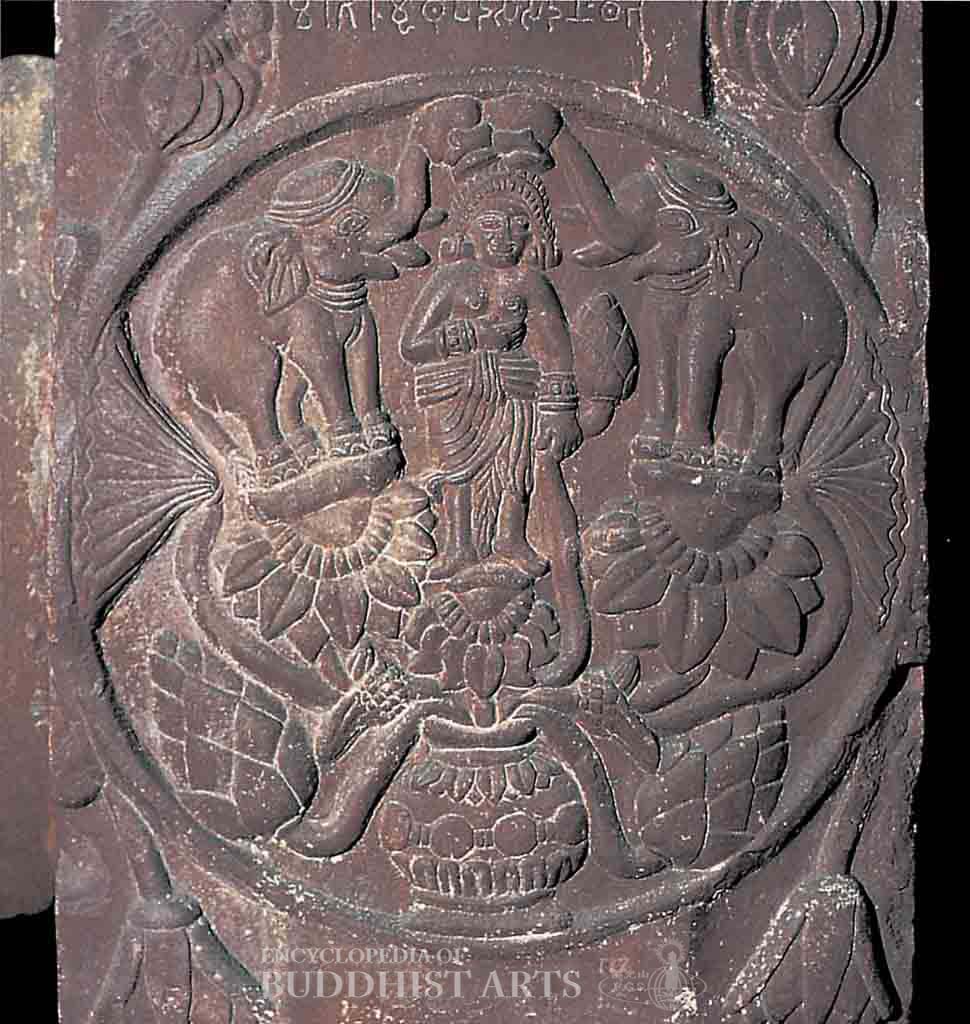
Bharhut: Gajalaksmi
Red sandstone
巴爾胡特遺址雙象灌頂圖
印度中央邦阿拉哈巴德瑟德納縣巴爾胡特遺址出土
印度中央邦阿拉哈巴德瑟德納縣(Satna, Allahabad, Madhya Pradesh)巴爾胡特遺址(Bharhut)出土。原為佛塔圍欄柱石上的圓形浮雕。在印度,藥叉女拉克希米具有蓮花特質,經常和蓮花裝飾一起出現,而有蓮花女神之稱,為美與吉祥的象徵,自古以來深受印度民間崇拜。後來印度教崛起,歸之為毗濕奴的神妃,佛教則吸納作守護神,漢譯吉祥天。
浮雕下方有一滿瓶,內生出長莖蓮蕾,向兩側伸展;另有三朵盛開的蓮花向上並列,中央一朵承托女神拉克希米,兩側蓮花上為相對的大象。女神採正面立姿,上身瘦小,手腳粗壯,左手下垂握蓮莖,右手平舉。二象高舉長鼻,於女神頭頂灑水。滿瓶象徵孕育萬物的源泉,從中伸出的蓮花圖案則是繁榮、富饒、吉祥的象徵。植物群在印度各有搭配的神祇,這種思想早在雅利安人(Aryan)之前的時代就有。
For more details, go to the Encyclopedia of Buddhist Arts: Sculpture A-F, page 131.
Cite this article:
Hsingyun, et al. "Bharhut: Gajalaksmi." Encyclopedia of Buddhist Arts: Sculpture A-F, vol. 10, 2016, pp. 131.
Hsingyun, Youheng, Yann Lovelock, Yuan Chou, Susan Huntington, Gary Edson, and Robert Neather. 2016. "Bharhut: Gajalaksmi" In Encyclopedia of Buddhist Arts: Sculpture A-F, 10:131.
Hsingyun, Youheng, Lovelock, Y., Chou, Y., Huntington, S., Edson, G., & Neather, R.. (2016). Bharhut: Gajalaksmi. In Encyclopedia of Buddhist Arts: Sculpture A-F (Vol. 10, pp. 131).
@misc{Hsingyun2016,
author = Hsingyun and Youheng and Lovelock, Yann and Chou, Yuan and Huntington, Susan and Edson, Gary and Neather, Robert,
booktitle = {Encyclopedia of Buddhist Arts: Sculpture A-F},
pages = 131,
title = {{Bharhut: Gajalaksmi}},
volume = 10,
year = {2016}}
author = Hsingyun and Youheng and Lovelock, Yann and Chou, Yuan and Huntington, Susan and Edson, Gary and Neather, Robert,
booktitle = {Encyclopedia of Buddhist Arts: Sculpture A-F},
pages = 131,
title = {{Bharhut: Gajalaksmi}},
volume = 10,
year = {2016}}