
Bharhut: Gajalaksmi
Red sandstone
Bharhut: Gajalaksmi
INDIA, Madhya Pradesh, Bharhut
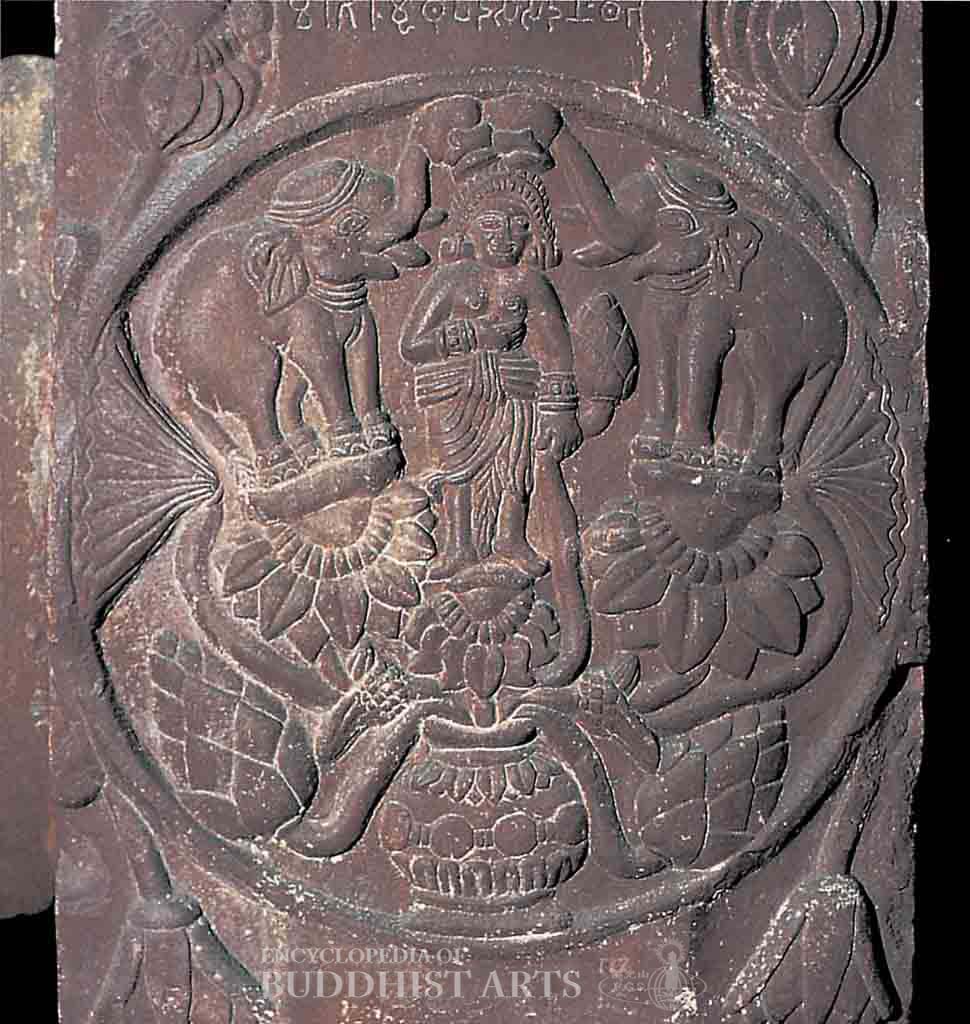
The goddess is shown in her aspect as Gajalaksmi and was later included in the Buddhist pantheon under the name of “the great goddess,” Mahadevi. At the time, Bharhut carving was under the control of a Brahmanical dynasty and local sculptors incorporated all kinds of local lore into their work. The goddess in the medallion stands upon a lotus rising from a vase filled with flowers, which represent fertility and auspiciousness. Elephants, also standing on lotuses, raise their trunks on either side to shower her from vases in a version of the lavation ceremony that is part of Hindu iconography for this form of the goddess.
The lotus theme is continued onto the post, where two swans perch on buds. Between them is an inscription naming the donor as Thupadasi of Moragiri. The name is interesting since it appears to be a title meaning a stupa’s dedicated maidservant or devotee and so offers evidence of formalized stupa worship at this date.
For more details, go to the Encyclopedia of Buddhist Arts: Sculpture A-F, page 131.
Cite this article:
author = Hsingyun and Youheng and Lovelock, Yann and Chou, Yuan and Huntington, Susan and Edson, Gary and Neather, Robert,
booktitle = {Encyclopedia of Buddhist Arts: Sculpture A-F},
pages = 131,
title = {{Bharhut: Gajalaksmi}},
volume = 10,
year = {2016}}