
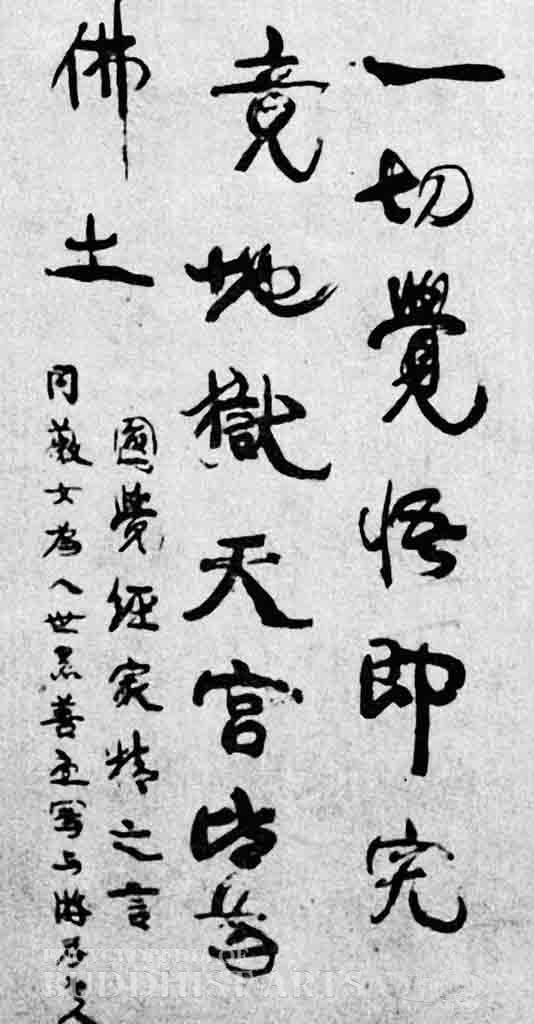
Hell and Heaven Are Both Buddha Realms
Ink on paper
佛語 康有為
中國
此幅乃康有為書以贈人。凡五行,三十七字。內容說明覺悟之後,則心淨佛土淨,所以有「地獄天宮皆為佛土」之謂。此外,亦可由此幅內容,考察康有為之佛教思想。
清代(1644~1911)最有影響的書法理論家,首推康有為。此幅帶有圓筆寬綽而綿長雄渾之氣,字字皆能完全表現康有為之書寫特色,雖字字獨立而行氣略於連貫,但其書風配以所書佛語,真有覺悟之氣勢,誠為佳作。
康有為原名祖詒,字廣廈,又字更生,號長素,人稱康南海或南海先生。廣東南海人。工書法,初學歐陽詢、趙孟頫,兼學蘇軾、米芾,推崇北碑,書風自成一格。
參考釋文:一切覺悟即究/竟地獄天宮皆為/佛土 圓覺經最精之言/同薇女為入世思善堂寫與游存老人
For more details, go to the Encyclopedia of Buddhist Arts: Calligraphy, page 98.
Cite this article:
Hsingyun, et al. "Hell and Heaven Are Both Buddha Realms." Encyclopedia of Buddhist Arts: Calligraphy , vol. 17, 2016, pp. 98.
Hsingyun, Youheng, Youlu, Stefanie Pokorski, Mankuang, and Gary Edson. 2016. "Hell and Heaven Are Both Buddha Realms" In Encyclopedia of Buddhist Arts: Calligraphy , 17:98.
Hsingyun, Youheng, Youlu, Pokorski, S., Mankuang, & Edson, G.. (2016). Hell and Heaven Are Both Buddha Realms. In Encyclopedia of Buddhist Arts: Calligraphy (Vol. 17, pp. 98).
@misc{Hsingyun2016,
author = Hsingyun and Youheng and Youlu and Pokorski, Stefanie and Mankuang and Edson, Gary,
booktitle = {Encyclopedia of Buddhist Arts: Calligraphy },
pages = 98,
title = {{Hell and Heaven Are Both Buddha Realms}},
volume = 17,
year = {2016}}
author = Hsingyun and Youheng and Youlu and Pokorski, Stefanie and Mankuang and Edson, Gary,
booktitle = {Encyclopedia of Buddhist Arts: Calligraphy },
pages = 98,
title = {{Hell and Heaven Are Both Buddha Realms}},
volume = 17,
year = {2016}}