
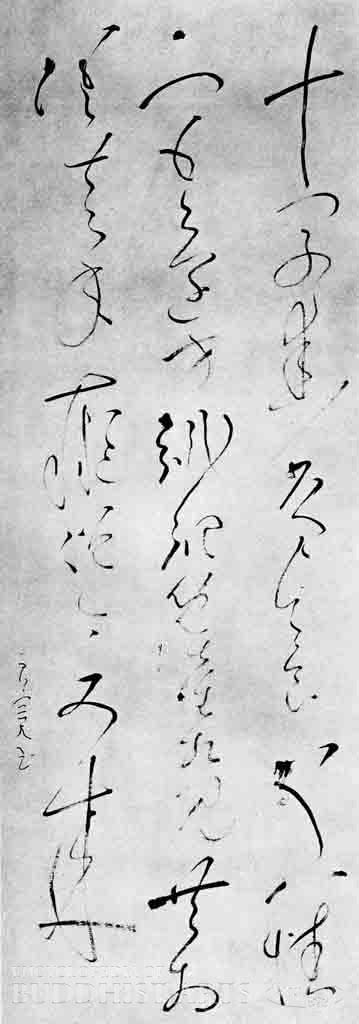
Seven-Character Quatrain
Ink on paper
七言絕句 良寬
日本
良寬和尚詩書作品中,以書寫其日常生活者最為人所敬所賞。此軸即良寬自述托鉢化緣,兒童相見而笑語相對之事。凡三行,二十八字。
就紀錄所見,良寬對於中日書法大師皆有所臨習、取法,其草書一體,可以清楚見到唐代(618~907)僧人懷素《自敘帖》的影響。然而,良寬所書者並無懷素之圓勁,其飛白也不似懷素書作的強烈速度感,而是展現清淡的用筆,是良寬書風之迷人處。
良寬為日本江戶時代(1615~1868)後期的禪僧,其一生住草庵,行乞食,孤獨清貧而自在灑脫。
參考釋文:十字街頭乞食了八幡/宮邊方徘徊兒童相見共相/語去年癡僧今又來/良寬書
For more details, go to the Encyclopedia of Buddhist Arts: Calligraphy, page 226.
Cite this article:
Hsingyun, et al. "Seven-Character Quatrain." Encyclopedia of Buddhist Arts: Calligraphy , vol. 17, 2016, pp. 226.
Hsingyun, Youheng, Youlu, Stefanie Pokorski, Mankuang, and Gary Edson. 2016. "Seven-Character Quatrain" In Encyclopedia of Buddhist Arts: Calligraphy , 17:226.
Hsingyun, Youheng, Youlu, Pokorski, S., Mankuang, & Edson, G.. (2016). Seven-Character Quatrain. In Encyclopedia of Buddhist Arts: Calligraphy (Vol. 17, pp. 226).
@misc{Hsingyun2016,
author = Hsingyun and Youheng and Youlu and Pokorski, Stefanie and Mankuang and Edson, Gary,
booktitle = {Encyclopedia of Buddhist Arts: Calligraphy },
pages = 226,
title = {{Seven-Character Quatrain}},
volume = 17,
year = {2016}}
author = Hsingyun and Youheng and Youlu and Pokorski, Stefanie and Mankuang and Edson, Gary,
booktitle = {Encyclopedia of Buddhist Arts: Calligraphy },
pages = 226,
title = {{Seven-Character Quatrain}},
volume = 17,
year = {2016}}