
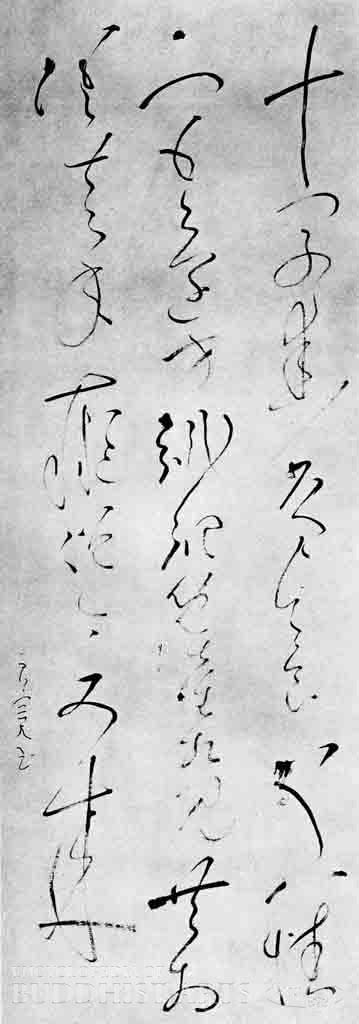
Seven-Character Quatrain
Ink on paper
Seven-Character Quatrain
JAPAN; Edo period
Among Ryokan’s poetic works, the better-received ones are those describing his daily life. In this scroll, Ryokan wrote about one of his encounters while seeking alms, where children greeted him with laughter and joy. It comprises 28 characters in three lines.
Records indicate that Ryokan learned from many calligraphy masters from both Japan and China. His cursive script resembles that seen in Autobiography, by the Tang dynasty (618–907) calligrapher and monk, Huaisu. The arcing tendencies however are lacking in Ryokan’s work, and his use of flying white technique is not as aggressive as Huaisu’s. His brushstrokes are nevertheless refreshingly simple, which is an enigmatic aspect of his work.
Ryokan was a Zen monk of the late Edo period (1603–1868). He is known for having lived in a grass hut, begging for alms, and leading a liberated life as a hermit.
For more details, go to the Encyclopedia of Buddhist Arts: Calligraphy, page 226.
Cite this article:
author = Hsingyun and Youheng and Youlu and Pokorski, Stefanie and Mankuang and Edson, Gary,
booktitle = {Encyclopedia of Buddhist Arts: Calligraphy },
pages = 226,
title = {{Seven-Character Quatrain}},
volume = 17,
year = {2016}}