
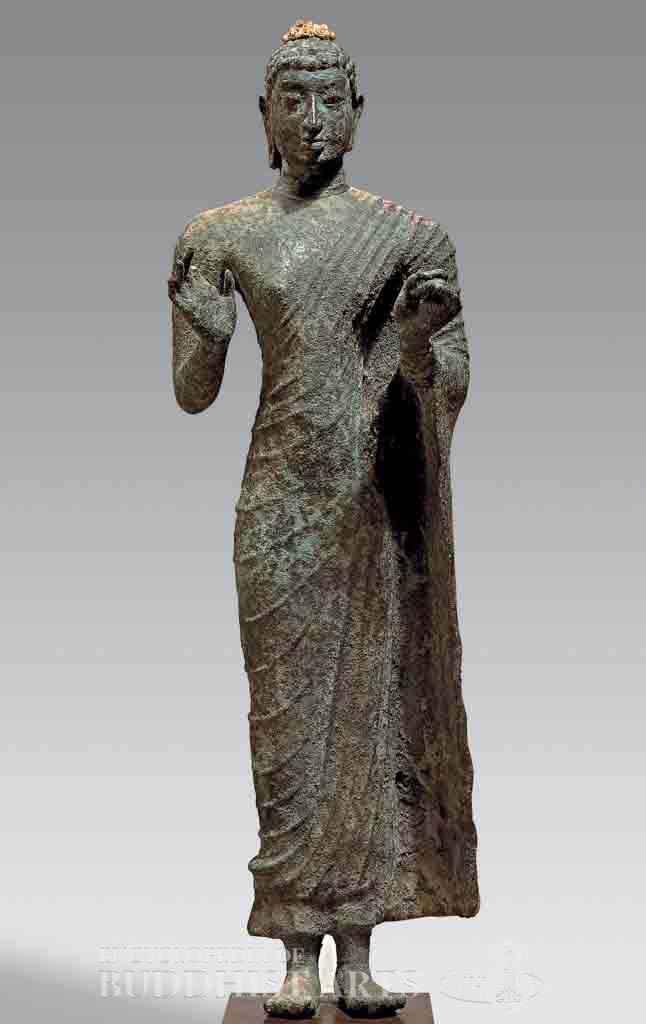
Java: Standing Buddha
Bronze
佛立像
印尼東爪哇省任抹縣出土
印尼東爪哇省任抹縣(Jember, East Java)出土。佛頭部螺髮粗大,部分已遭磨損,肉髻平緩,敷金;長目高鼻,面相清秀。身形修長俊逸,著貼體袒右袈裟,顯露出右側曲線,流暢而柔美;左側衣袖自然懸垂於肘下,較為寬鬆。凸起的衣紋疏朗有致,形成優美自然的弧線,既寫實又富裝飾意味。
由僧伽羅族(Sinhalese)建立的僧伽羅國(今斯里蘭卡),因地緣鄰近印度,而承襲了阿瑪拉瓦提佛教造像風格,此類型被稱之為僧伽羅樣式,並流傳至東南亞其他國家,此像即為其中佳作。
For more details, go to the Encyclopedia of Buddhist Arts: Sculpture G-M, page 488.
Cite this article:
Hsingyun, et al. "Java: Standing Buddha." Encyclopedia of Buddhist Arts: Sculpture G-M, vol. 11, 2016, pp. 488.
Hsingyun, Youheng, Yann Lovelock, Yuan Chou, Susan Huntington, Gary Edson, and Robert Neather. 2016. "Java: Standing Buddha" In Encyclopedia of Buddhist Arts: Sculpture G-M, 11:488.
Hsingyun, Youheng, Lovelock, Y., Chou, Y., Huntington, S., Edson, G., & Neather, R.. (2016). Java: Standing Buddha. In Encyclopedia of Buddhist Arts: Sculpture G-M (Vol. 11, pp. 488).
@misc{Hsingyun2016,
author = Hsingyun and Youheng and Lovelock, Yann and Chou, Yuan and Huntington, Susan and Edson, Gary and Neather, Robert,
booktitle = {Encyclopedia of Buddhist Arts: Sculpture G-M},
pages = 488,
title = {{Java: Standing Buddha}},
volume = 11,
year = {2016}}
author = Hsingyun and Youheng and Lovelock, Yann and Chou, Yuan and Huntington, Susan and Edson, Gary and Neather, Robert,
booktitle = {Encyclopedia of Buddhist Arts: Sculpture G-M},
pages = 488,
title = {{Java: Standing Buddha}},
volume = 11,
year = {2016}}