
Tea and Chan Are of One Taste
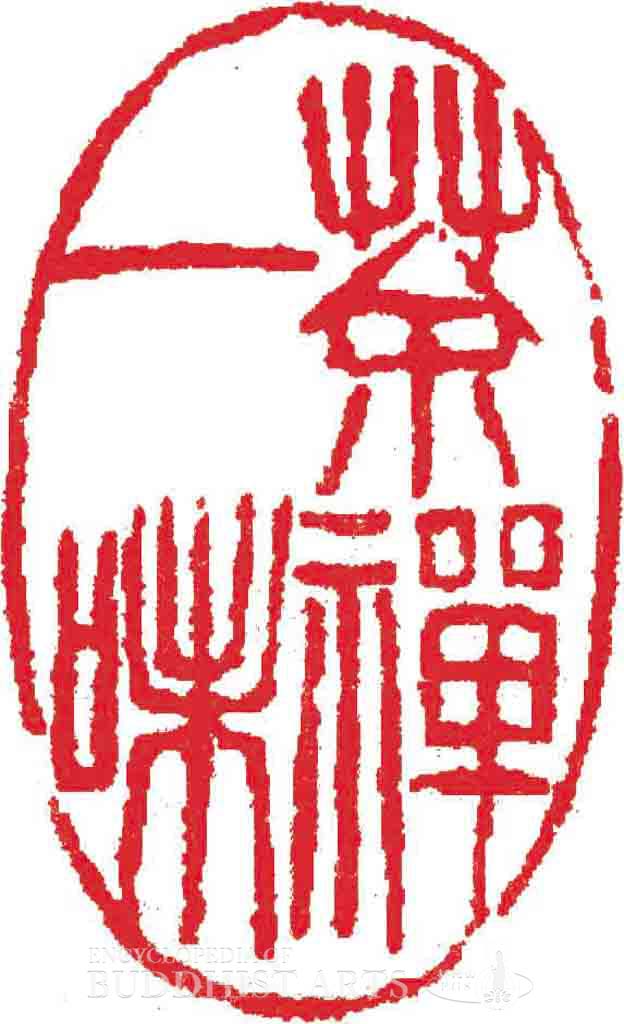
Red-character oval seal
茶禪一味 錢瘦鐵
中國
「茶禪一味」,正是反映茶道與禪心的默契,旨在消除常人的妄想,即所謂「佛法但平常,莫作奇特想」。
此為四字朱文印,用橢圓形的印面刻成,印文章法以四等份平均分布,印文中的「一」字與邊欄相連,增加印面的安定感。
其次,比較特殊的是篆體改變,將繆篆方正的結構向上延伸,如小篆般的修長比例,以直線為主,每一條筆畫皆有粗細變化,呈現質樸古茂特色,而別開生面,氣勢雄渾。
運刀以澀刀為主,無板滯之刻劃。印章邊欄斑駁自然,雖取法吳昌碩,而不受拘泥,自成一格。
錢瘦鐵名崖,字瘦鐵,以字行,號芋香宧主,別號數青峰館主等。江蘇無錫人。早年為刻碑店學徒,得識金石家鄭大鶴(文焯),為其入室弟子;篆刻受教於吳昌碩,不囿師門,自成面目,作品古雅拙樸,蒼勁渾厚。曾任日本《書苑》雜誌編輯顧問,而影響日本藝壇。存世有《錢瘦鐵作品集》。
For more details, go to the Encyclopedia of Buddhist Arts: Calligraphy, page 331.
Cite this article:
Hsingyun, et al. "Tea and Chan Are of One Taste." Encyclopedia of Buddhist Arts: Calligraphy , vol. 17, 2016, pp. 331.
Hsingyun, Youheng, Youlu, Stefanie Pokorski, Mankuang, and Gary Edson. 2016. "Tea and Chan Are of One Taste" In Encyclopedia of Buddhist Arts: Calligraphy , 17:331.
Hsingyun, Youheng, Youlu, Pokorski, S., Mankuang, & Edson, G.. (2016). Tea and Chan Are of One Taste. In Encyclopedia of Buddhist Arts: Calligraphy (Vol. 17, pp. 331).
@misc{Hsingyun2016,
author = Hsingyun and Youheng and Youlu and Pokorski, Stefanie and Mankuang and Edson, Gary,
booktitle = {Encyclopedia of Buddhist Arts: Calligraphy },
pages = 331,
title = {{Tea and Chan Are of One Taste}},
volume = 17,
year = {2016}}
author = Hsingyun and Youheng and Youlu and Pokorski, Stefanie and Mankuang and Edson, Gary,
booktitle = {Encyclopedia of Buddhist Arts: Calligraphy },
pages = 331,
title = {{Tea and Chan Are of One Taste}},
volume = 17,
year = {2016}}