
Tea and Chan Are of One Taste
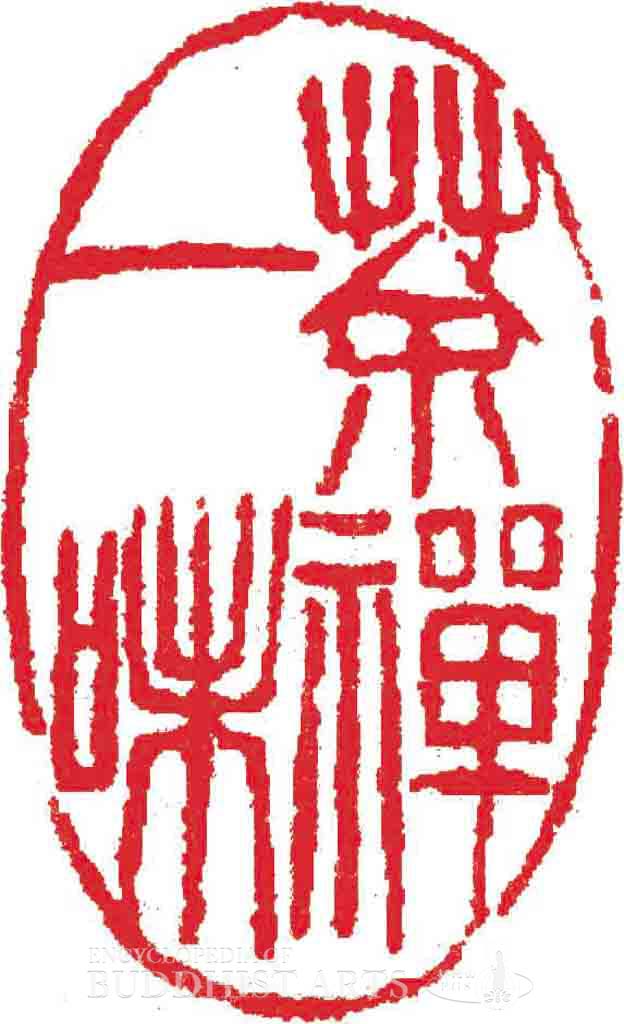
Red-character oval seal
Tea and Chan Are of One Taste
CHINA
The text of this seal implies the inherent harmony that exists between the tea ceremony and a meditative mind, which is aimed at eradicating delusive thoughts.
In its layout, this seal is simple and sturdy, departing from the ordinary and expressing a fresh style full of vigor and strength. Knife cuts were executed as if they were carved with a calligraphy brush, as evinced by the absence of dull strokes that develop a natural albeit naive personality. While the carving technique takes after that of Wu Changshuo, it is not inhibited in anyway. Rather, the strengths of various schools were employed broadly across the seal in a way that flows smoothly in accompaniment to the twists and turns of each character stroke, resulting in a uniquely new style.
Qian Shoutie was a native of Wuxi, Jiangsu. In his early years, he became acquainted with the epigrapher, Cheng Dahe, under whom he would later study and become a close disciple. Qian also learned the art of seal engraving from Wu Changshuo.
For more details, go to the Encyclopedia of Buddhist Arts: Calligraphy, page 331.
Cite this article:
author = Hsingyun and Youheng and Youlu and Pokorski, Stefanie and Mankuang and Edson, Gary,
booktitle = {Encyclopedia of Buddhist Arts: Calligraphy },
pages = 331,
title = {{Tea and Chan Are of One Taste}},
volume = 17,
year = {2016}}