
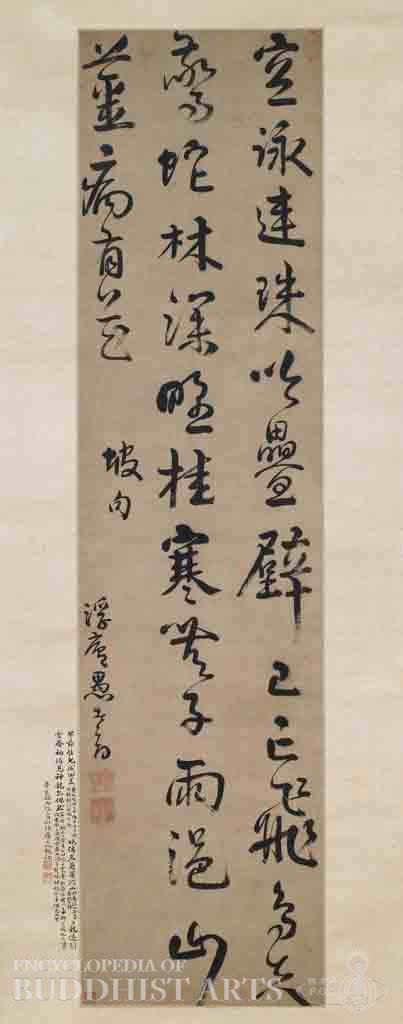
Seven-Character Quatrain
Ink on paper
七言絕句 釋弘智
中國
書寫者為明(1368~1644)末清(1644~1911)初弘智禪師,其書寫內容為:「空詠連珠吟疊壁,已亡飛鳥失驚蛇。林深野桂寒無子,雨浥山薑病有花」,乃是節錄宋代(960~1279)蘇軾詩作《天竺寺》而來。
此作字字獨立,字架、章法寬博疏朗,即使是快速書寫的單字,字中點畫布排也相當均勻,加上用筆圓厚而明確,可說是顏真卿書法傳統影響下的書寫風格取向。同時,也表現了書寫者堂堂正正的氣象與美學趣味。
弘智禪師俗姓方,名以智,字密之,號藥地、愚者、浮山僧。明末清初僧人、學者。安徽桐城人。博通詩文、詞曲、書畫。作品多以禪語自喻,於畫趣中追求禪機。
參考釋文:空詠連珠吟疊壁已亡飛鳥失/驚蛇林深野桂寒無子雨浥山/薑病有花 坡句 浮廬愚老翁
For more details, go to the Encyclopedia of Buddhist Arts: Calligraphy, page 225.
Cite this article:
Hsingyun, et al. "Seven-Character Quatrain." Encyclopedia of Buddhist Arts: Calligraphy , vol. 17, 2016, pp. 225.
Hsingyun, Youheng, Youlu, Stefanie Pokorski, Mankuang, and Gary Edson. 2016. "Seven-Character Quatrain" In Encyclopedia of Buddhist Arts: Calligraphy , 17:225.
Hsingyun, Youheng, Youlu, Pokorski, S., Mankuang, & Edson, G.. (2016). Seven-Character Quatrain. In Encyclopedia of Buddhist Arts: Calligraphy (Vol. 17, pp. 225).
@misc{Hsingyun2016,
author = Hsingyun and Youheng and Youlu and Pokorski, Stefanie and Mankuang and Edson, Gary,
booktitle = {Encyclopedia of Buddhist Arts: Calligraphy },
pages = 225,
title = {{Seven-Character Quatrain}},
volume = 17,
year = {2016}}
author = Hsingyun and Youheng and Youlu and Pokorski, Stefanie and Mankuang and Edson, Gary,
booktitle = {Encyclopedia of Buddhist Arts: Calligraphy },
pages = 225,
title = {{Seven-Character Quatrain}},
volume = 17,
year = {2016}}