
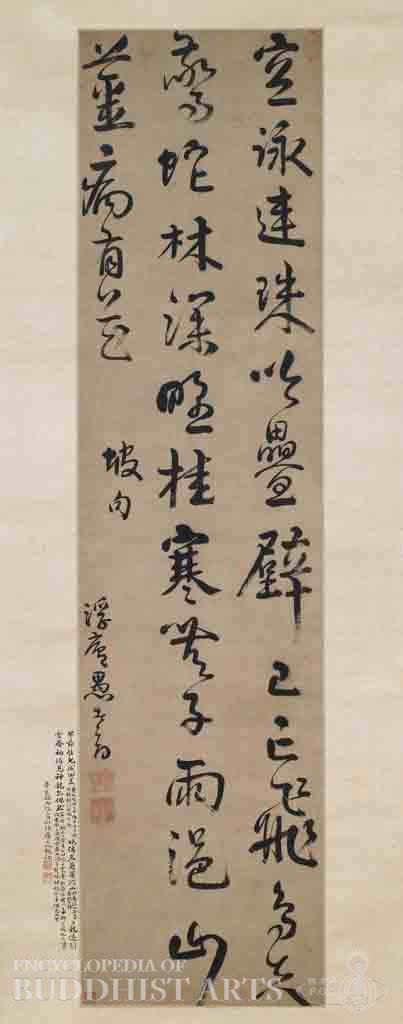
Seven-Character Quatrain
Ink on paper
Seven-Character Quatrain
CHINA; Ming to Qing dynasty
Hongzhi, a Chan master who lived between the late Ming (1368–1644) and early Qing (1644–1911) dynasties, wrote this piece. The Song dynasty (960–1279) poet, Su Shi composed the poem Tianzhu Temple from which these four lines are extracted.
The characters are broad and spacious in form, and remain well-arranged. The brushstrokes are thick and concise despite the hasty execution. This distinguished and forthright style, although influenced by the calligraphy of Yan Zhenqing, reflects the personality and the aesthetic sensibility of Master Hongzhi.
Hongzhi’s original name was Fang Yizhi, and he was also known as Mizhi. He was a Chan master and scholar from Tongcheng, Anhui, and was well versed in poetry, literature, painting, and calligraphy. His works are often filled with Chan metaphors and subtleties.
For more details, go to the Encyclopedia of Buddhist Arts: Calligraphy, page 225.
Cite this article:
author = Hsingyun and Youheng and Youlu and Pokorski, Stefanie and Mankuang and Edson, Gary,
booktitle = {Encyclopedia of Buddhist Arts: Calligraphy },
pages = 225,
title = {{Seven-Character Quatrain}},
volume = 17,
year = {2016}}