
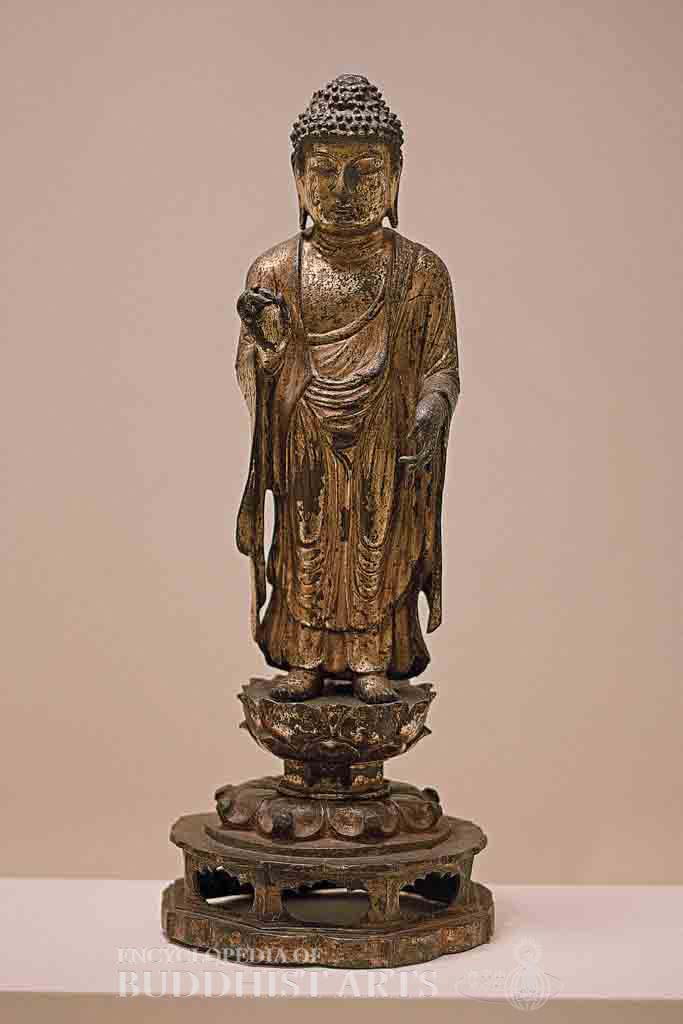
Gyeongju: Standing Buddha
Gilt bronze
佛立像
韓國
八世紀統一新羅時期(668~935)的政治和文化達到高峰期,首都慶州佛寺遺址及佛塔內發現大小不一的佛像,顯示佛像遍布各處。佛寺殿堂主要供奉大佛像,小佛像則供奉於私人佛堂。
該像立於八角形台上,台下為仰覆蓮瓣。佛螺髮,臉部圓潤,袈裟下襬衣紋為波浪狀。右手上舉,似作無畏印,手指部分損壞;左手似作與願印。背面兩處凸出的圓柄顯示原應配有背光。
統一新羅時期佛像因受中國唐朝(618~907)影響,體態豐腴、圓臉、寬肩等,但臉部表情肅穆,足部波浪狀衣褶,是八世紀韓國造像的特徵。
For more details, go to the Encyclopedia of Buddhist Arts: Sculpture G-M, page 405.
Cite this article:
Hsingyun, et al. "Gyeongju: Standing Buddha." Encyclopedia of Buddhist Arts: Sculpture G-M, vol. 11, 2016, pp. 405.
Hsingyun, Youheng, Yann Lovelock, Yuan Chou, Susan Huntington, Gary Edson, and Robert Neather. 2016. "Gyeongju: Standing Buddha" In Encyclopedia of Buddhist Arts: Sculpture G-M, 11:405.
Hsingyun, Youheng, Lovelock, Y., Chou, Y., Huntington, S., Edson, G., & Neather, R.. (2016). Gyeongju: Standing Buddha. In Encyclopedia of Buddhist Arts: Sculpture G-M (Vol. 11, pp. 405).
@misc{Hsingyun2016,
author = Hsingyun and Youheng and Lovelock, Yann and Chou, Yuan and Huntington, Susan and Edson, Gary and Neather, Robert,
booktitle = {Encyclopedia of Buddhist Arts: Sculpture G-M},
pages = 405,
title = {{Gyeongju: Standing Buddha}},
volume = 11,
year = {2016}}
author = Hsingyun and Youheng and Lovelock, Yann and Chou, Yuan and Huntington, Susan and Edson, Gary and Neather, Robert,
booktitle = {Encyclopedia of Buddhist Arts: Sculpture G-M},
pages = 405,
title = {{Gyeongju: Standing Buddha}},
volume = 11,
year = {2016}}