
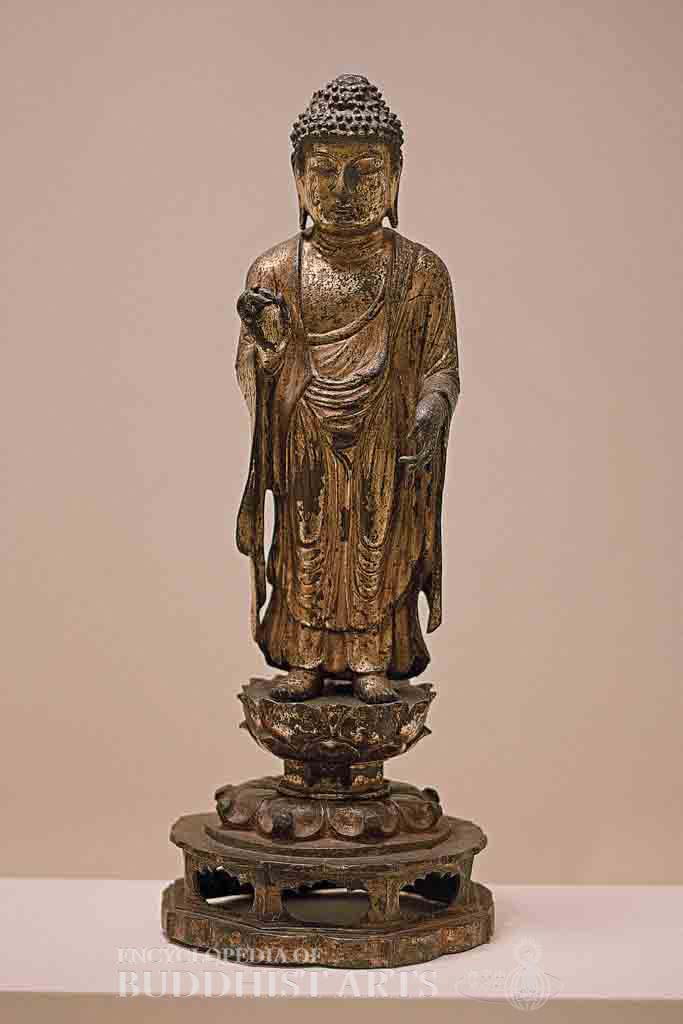
Gyeongju: Standing Buddha
Gilt bronze
Gyeongju: Standing Buddha
SOUTH KOREA, North Gyeongsang, Gyeongju; Unified Silla dynasty
Found in Gyeongju, the statue stands upon a waisted lotus pedestal, supported on an openwork octagonal stand. The figure raises the right hand and wears a monastic robe that covers both shoulders, then opens at the front to reveal an inner robe. Long sleeves fall down the body and the folds ripple over the thighs, stopping short at the skirt below. The presence of the extra layer of fabric at the ankles is an 8th century feature. The style of the statue may show the influence of the Tang dynasty (618–907) of China, also evident in the well-rounded face and sloping shoulders. Two tenons at the back indicate where a mandorla was originally secured.
For more details, go to the Encyclopedia of Buddhist Arts: Sculpture G-M, page 405.
Cite this article:
Hsingyun, et al. "Gyeongju: Standing Buddha." Encyclopedia of Buddhist Arts: Sculpture G-M, vol. 11, 2016, pp. 405.
Hsingyun, Youheng, Yann Lovelock, Yuan Chou, Susan Huntington, Gary Edson, and Robert Neather. 2016. "Gyeongju: Standing Buddha" In Encyclopedia of Buddhist Arts: Sculpture G-M, 11:405.
Hsingyun, Youheng, Lovelock, Y., Chou, Y., Huntington, S., Edson, G., & Neather, R.. (2016). Gyeongju: Standing Buddha. In Encyclopedia of Buddhist Arts: Sculpture G-M (Vol. 11, pp. 405).
@misc{Hsingyun2016,
author = Hsingyun and Youheng and Lovelock, Yann and Chou, Yuan and Huntington, Susan and Edson, Gary and Neather, Robert,
booktitle = {Encyclopedia of Buddhist Arts: Sculpture G-M},
pages = 405,
title = {{Gyeongju: Standing Buddha}},
volume = 11,
year = {2016}}
author = Hsingyun and Youheng and Lovelock, Yann and Chou, Yuan and Huntington, Susan and Edson, Gary and Neather, Robert,
booktitle = {Encyclopedia of Buddhist Arts: Sculpture G-M},
pages = 405,
title = {{Gyeongju: Standing Buddha}},
volume = 11,
year = {2016}}