
Amaravati: Paying Respect to the Buddha’s Footprints
Limestone
Amaravati: Paying Respect to the Buddha’s Footprints
INDIA, Andhra Pradesh, Amaravati; Satavahana period
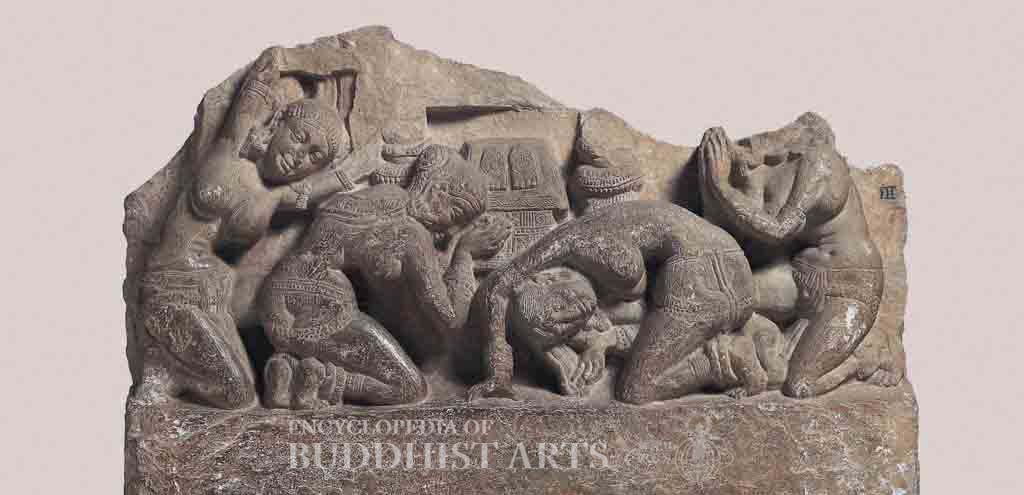
Only the lower section remains of the relief that once decorated the Amaravati Stupa. Twin footprints marked with the Dharma wheel are the center of attention. The footprints represent the place where the Buddha’s feet touched. It is considered that the type of worship portrayed was part of established religious practice at the time.
The emphasis on the bodies of the women is characteristic of the developing Amaravati style. The composition of the work has an elegant and harmonious rhythm typical of the crowded narrative work found at the site.
For more details, go to the Encyclopedia of Buddhist Arts: Sculpture A-F, page 24.
Cite this article:
Hsingyun, et al. "Amaravati: Paying Respect to the Buddha’s Footprints." Encyclopedia of Buddhist Arts: Sculpture A-F, vol. 10, 2016, pp. 24.
Hsingyun, Youheng, Yann Lovelock, Yuan Chou, Susan Huntington, Gary Edson, and Robert Neather. 2016. "Amaravati: Paying Respect to the Buddha’s Footprints" In Encyclopedia of Buddhist Arts: Sculpture A-F, 10:24.
Hsingyun, Youheng, Lovelock, Y., Chou, Y., Huntington, S., Edson, G., & Neather, R.. (2016). Amaravati: Paying Respect to the Buddha’s Footprints. In Encyclopedia of Buddhist Arts: Sculpture A-F (Vol. 10, pp. 24).
@misc{Hsingyun2016,
author = Hsingyun and Youheng and Lovelock, Yann and Chou, Yuan and Huntington, Susan and Edson, Gary and Neather, Robert,
booktitle = {Encyclopedia of Buddhist Arts: Sculpture A-F},
pages = 24,
title = {{Amaravati: Paying Respect to the Buddha’s Footprints}},
volume = 10,
year = {2016}}
author = Hsingyun and Youheng and Lovelock, Yann and Chou, Yuan and Huntington, Susan and Edson, Gary and Neather, Robert,
booktitle = {Encyclopedia of Buddhist Arts: Sculpture A-F},
pages = 24,
title = {{Amaravati: Paying Respect to the Buddha’s Footprints}},
volume = 10,
year = {2016}}