
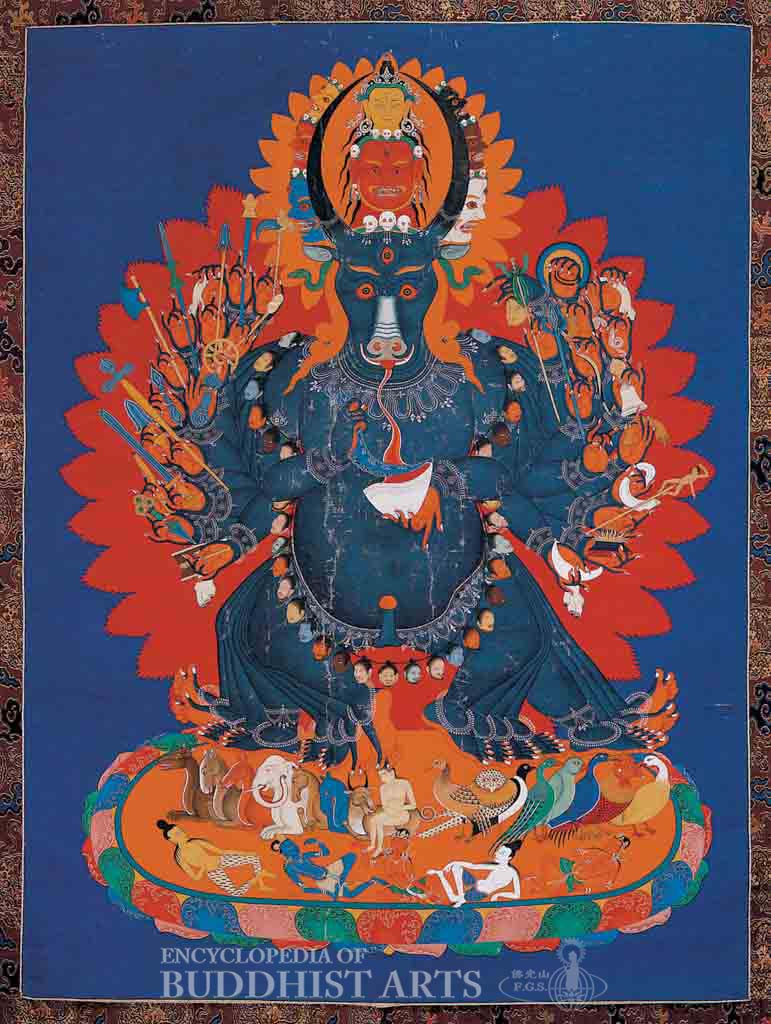
Yamantaka
Color on cloth
Yamantaka
CHINA, Tibet; Ming dynasty
Yamantaka, also known as Vajrabhairava, is one of the principal deities of the Gelug school. The figure has 9 heads, 34 arms, and 16 legs, each with a symbolic meaning. The central blue ox head drinks a stream of blood from a skull cup held in one of the left hands. Some of the other heads are arranged along the ox’s horns, an extremely rare configuration. The hands hold Dharma instruments and symbolic objects. A garland of severed heads hangs around the neck. The borders of the nimbus and the aureole are demarcated with precise flame and petal patterns. The feet rest upon vividly painted animals and birds that represent attainment and freedom. Five Indian deities including Brahma, Sakra, and Mahesvara sit at ease below the animals; they are usually shown being trampled by Yamantaka. Based on the dark blue background and the multi-colored petals on the lotus pedestal, the thangka was likely painted after the 16th century.
For more details, go to the Encyclopedia of Buddhist Arts: Painting P-Z, page 1040.
Cite this article:
author = Hsingyun and Youheng and Youlu and Wilson, Graham and Manho and Mankuang and Huntington, Susan,
booktitle = {Encyclopedia of Buddhist Arts: Painting P-Z},
pages = 1040,
title = {{Yamantaka}},
volume = 16,
year = {2016}}