
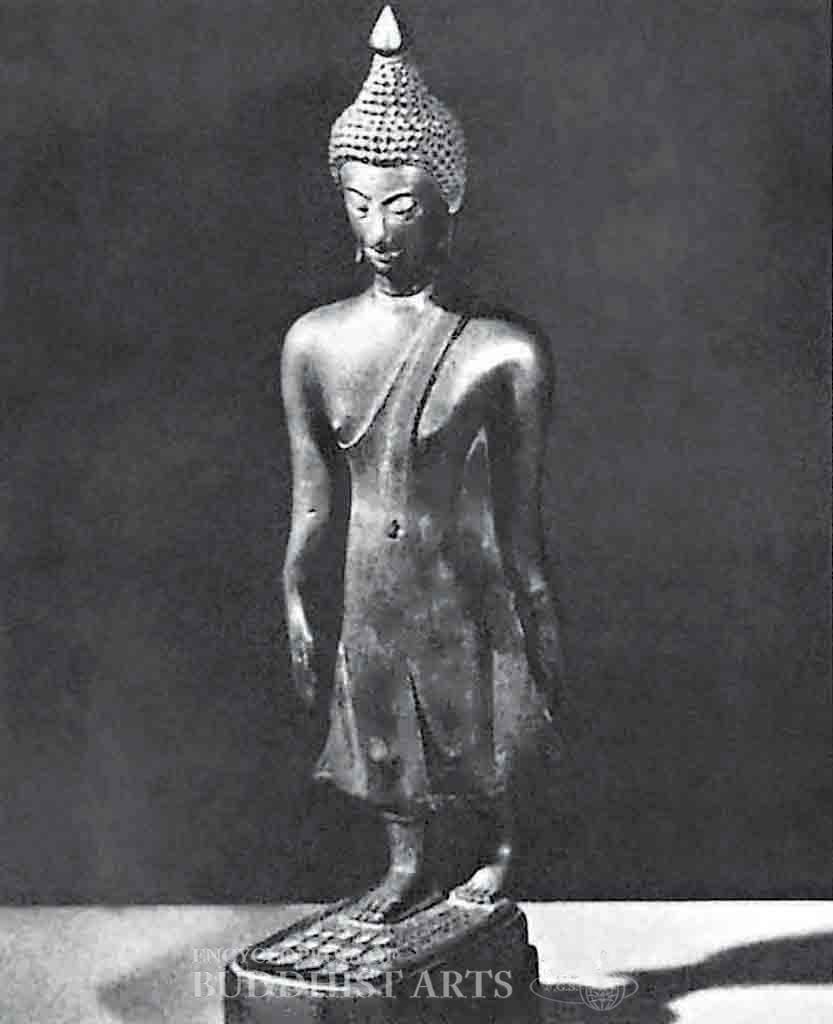
Walking Buddha
Bronze
Walking Buddha
THAILAND; Lanna Thai Kingdom
This bronze sculpture dates from the Lanna Thai Kingdom (circa 1259–1558), and is most likely influenced by the Sukhothai (circa 1238–1438) style. Generally, such sculptures depict Sakyamuni Buddha in walking meditation. The sculpture, however, shows him stepping on the giant prints left on the same spot by the three other Buddhas that have preceded him, and in whose footsteps he is following.
The figure wears the stylized Thai crown modeled on the Buddha’s attributes of conical usnisa and rounded curls. The eyes are focused on the feet. The figure is leaning slightly forward with hands moving naturally by his side. The three overlapping rectangular footprints gradually increase in size, the largest being as wide as the pedestal. This represents the belief that the Buddhas of the Past gradually decreased in size and length of life as virtue declined over time with Sakyamuni being the smallest.
For more details, go to the Encyclopedia of Buddhist Arts: Sculpture St-Z, page 1303.
Cite this article:
author = Hsingyun and Youheng and Lovelock, Yann and Chou, Yuan and Huntington, Susan and Edson, Gary and Neather, Robert,
booktitle = {Encyclopedia of Buddhist Arts: Sculpture St-Z},
pages = 1303,
title = {{Walking Buddha}},
volume = 13,
year = {2016}}