
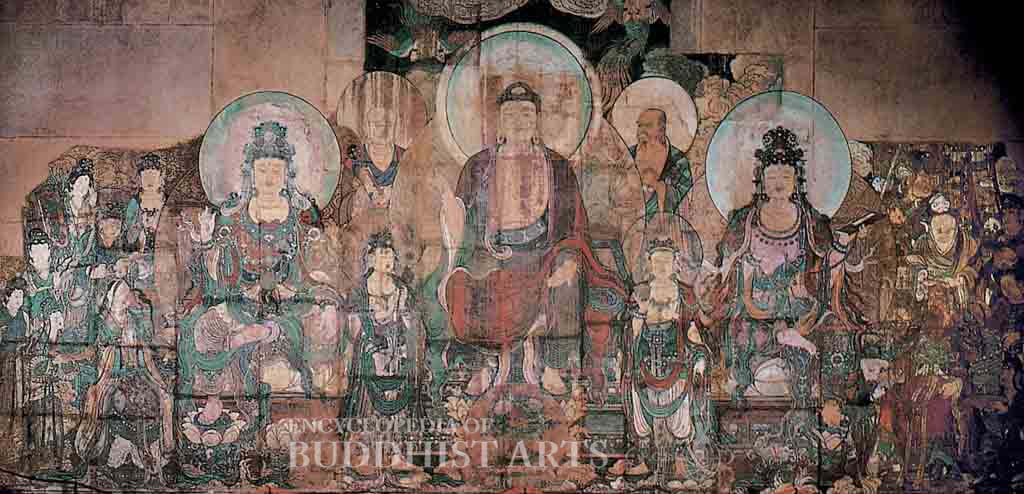
Xinghua Temple: Illustration of the Sutra on the Descent of Maitreya
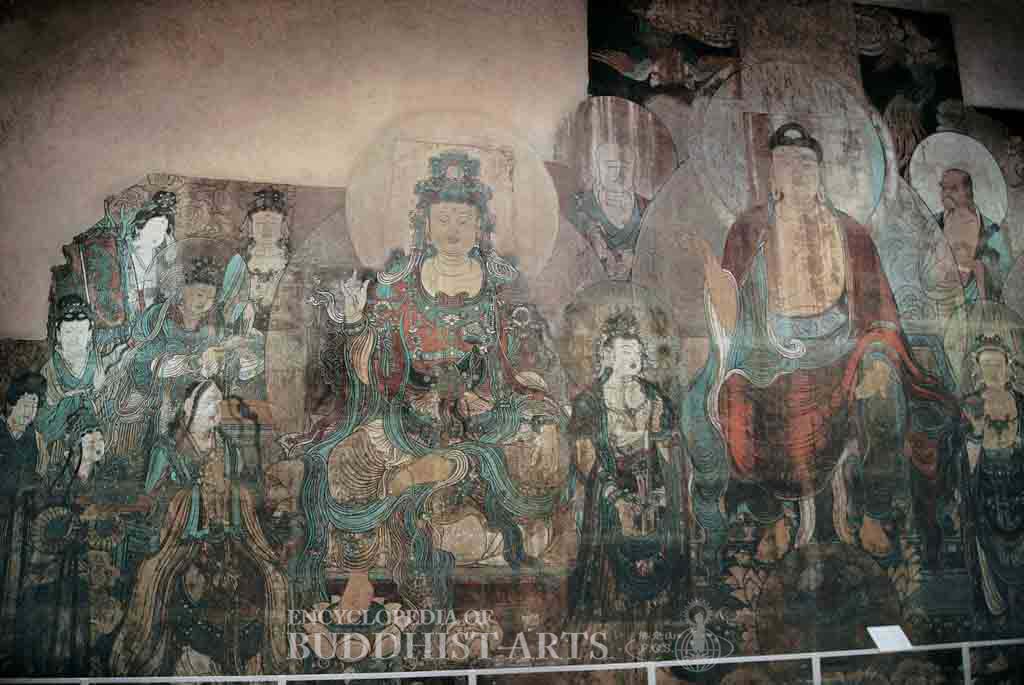
Xinghua Temple: Illustration of the Sutra on the Descent of Maitreya (detail)
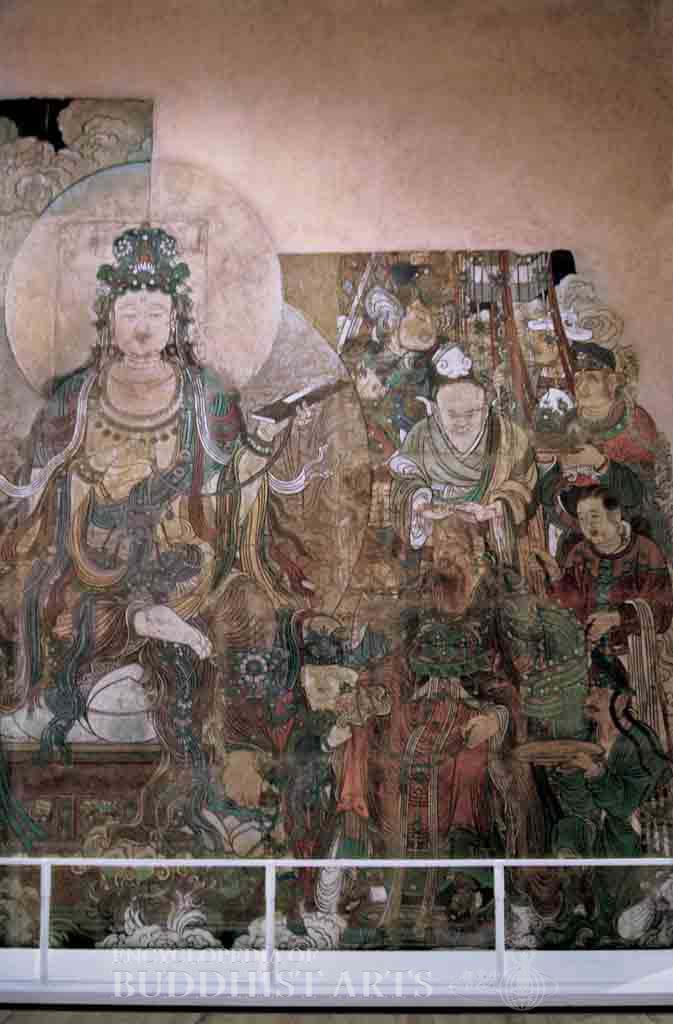
Xinghua Temple: Illustration of the Sutra on the Descent of Maitreya (detail)
Xinghua Temple: Illustration of the Sutra on the Descent of Maitreya
CHINA, Shanxi, Yuncheng; Yuan dynasty
Although Xinghua Temple has been destroyed, some of the murals painted on the walls were removed and preserved. Inscriptions state that this particular piece was painted by Zhu Haogu and Zhang Boyuan in 1298. The Sutra on the Descent of Maitreya states that after Maitreya attained enlightenment beneath the dragon flower tree, the cakravartin (wheel-turning monarch) King Sankha led 84,000 ministers and his daughter Samivati led 84,000 court ladies to listen to the Buddha teach the Dharma. After hearing Maitreya’s teachings, they immediately renounced worldly life and became monastics.
This illustration depicts the tonsure ceremony for King Sankha and his daughter Samivati. Maitreya Buddha sits in the center, dressed in a simple red robe and resting both feet on lotus pedestals. He is flanked by Manjusri and Samantabhadra, both wearing ornate headdresses and ornaments. All three central figures have large aureoles and nimbuses that appear to radiate light. Mahakasyapa, Ananda, and two attendant Bodhisattvas stand beside Maitreya. A pair of kalavinkas fly through the dark sky above the figures.
On the sides of the illustration, the king and his daughter are shown having their hair cut and heads shaved. The bearded King Sankha is depicted on the right, wearing a decorative robe and holding prayer beads. Samivati, shown on the left, joins her palms in reverence. Palace attendants carefully help them shave their heads. Other attendants carry fans, plates, and crowns. Vaisravana, Heavenly King of the North and Virudhaka, Heavenly King of the South stand behind King Sankha. A child is shown holding onto the king’s sleeve with one hand and wiping away tears with the other. According to the Sutra on Maitreya Attaining Buddhahood, After King Sankha and 999 other princes renounced, only one prince was left to succeed the throne. This child may represent the last remaining prince. The figures are painted with smooth, bold strokes reminiscent of the “Wu Daozi style” popular during the Tang dynasty (618– 907). Rich blue, green, red, and yellow colors give the scene an elegant appearance.
For more details, go to the Encyclopedia of Buddhist Arts: Painting P-Z, page 1035.
Cite this article:
author = Hsingyun and Youheng and Youlu and Wilson, Graham and Manho and Mankuang and Huntington, Susan,
booktitle = {Encyclopedia of Buddhist Arts: Painting P-Z},
pages = 1035,
title = {{Xinghua Temple: Illustration of the Sutra on the Descent of Maitreya}},
volume = 16,
year = {2016}}