
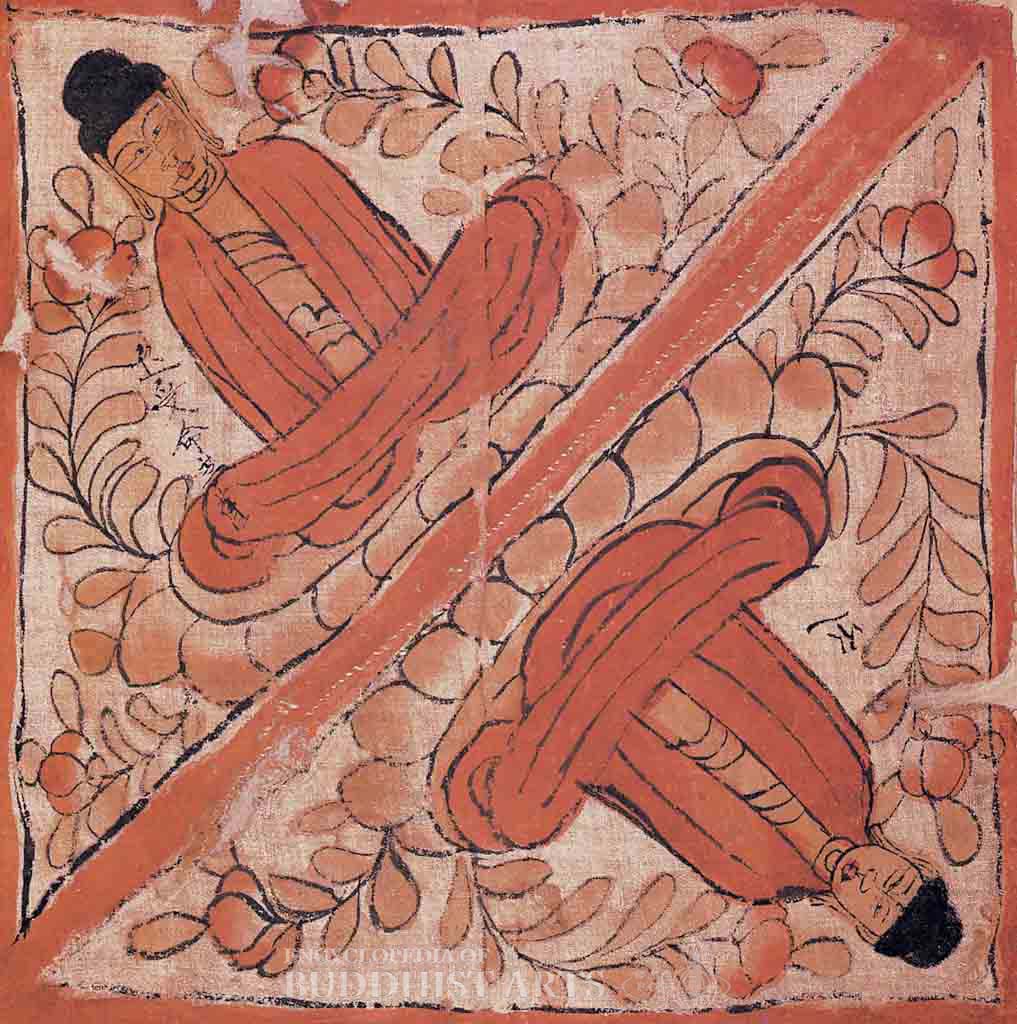
Yarhu: Longevity Bodhisattva
Ink and color on linen
Yarhu: Longevity Bodhisattva
CHINA, Xinjiang, Turpan; Tang dynasty
This painting was discovered at the ancient city of Yarhu by a Japanese expedition between 1908 and 1909. It is diagonally divided into two triangles containing symmetrical images of Bodhisattvas surrounded by leaves and flowers.
The Bodhisattvas have small eyes, elongated ears, and large topknots. They sit in full lotus position on lotus thrones, dressed in red monastic robes that cover their feet and hands. An inscription beside the Bodhisattva on the upper left reads “Longevity Bodhisattva.” Only one character, “Yan” (prolonging), is written beside the Bodhisattva on the lower right. There are traces of stitches within the diagonal hem that separates the two images. The figures were outlined with black ink before a wash of colors was applied. The composition has the simplistic, straightforward appearance of folk art.
For more details, go to the Encyclopedia of Buddhist Arts: Painting P-Z, page 1042.
Cite this article:
author = Hsingyun and Youheng and Youlu and Wilson, Graham and Manho and Mankuang and Huntington, Susan,
booktitle = {Encyclopedia of Buddhist Arts: Painting P-Z},
pages = 1042,
title = {{Yarhu: Longevity Bodhisattva}},
volume = 16,
year = {2016}}