
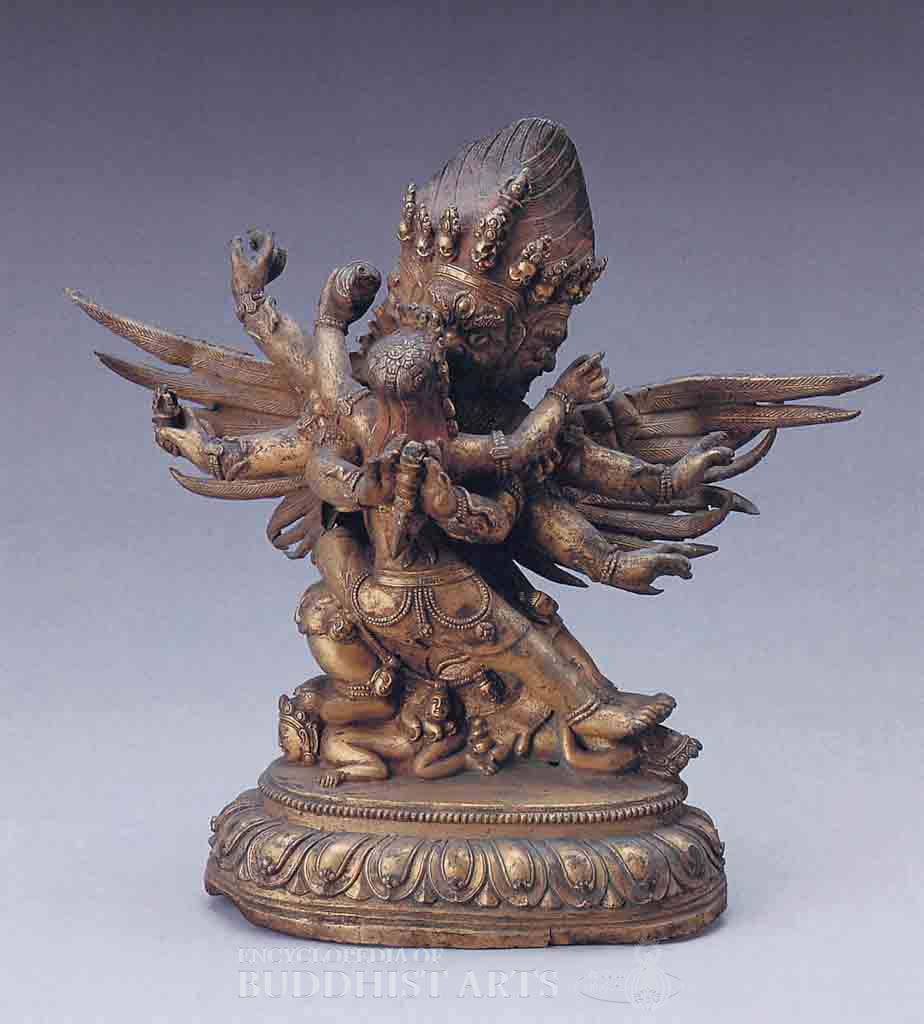
Vajrakila
Gilt copper alloy
Vajrakila
CHINA; Ming dynasty
Vajrakila, also known as Vajrakilaya or Vajrakumara, is a Vajrayana figure visualized as the personification of the kila, a cone-shaped ritual instrument. The figure holds this instrument in his principal hands as he embraces his consort Diptacakra. Vajrakila has three ferocious faces crowned with skulls around a bulging cranium. Feathered wings open from his back and he has six arms with a vajra held in one of the hands on the right but lost from the other. The figure wears snake bracelets on the wrists and is draped in an elephant hide. A garland of severed heads is held in place by the left leg of his consort wrapped about his waist. Evil spirits are trampled beneath their feet as they prance in the pratayalidha posture. Their dance symbolizes the subjugation of delusion and negative influences.
For more details, go to the Encyclopedia of Buddhist Arts: Sculpture St-Z, page 1292.
Cite this article:
author = Hsingyun and Youheng and Lovelock, Yann and Chou, Yuan and Huntington, Susan and Edson, Gary and Neather, Robert,
booktitle = {Encyclopedia of Buddhist Arts: Sculpture St-Z},
pages = 1292,
title = {{Vajrakila}},
volume = 13,
year = {2016}}