
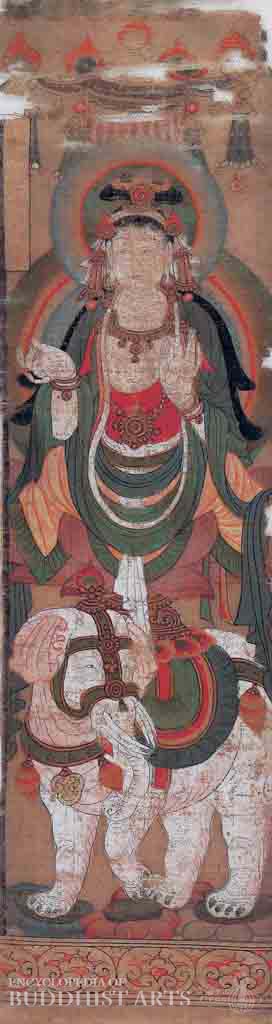
Mogao Cave 17: Samantabhadra Bodhisattva
Ink and color on silk
Mogao Cave 17: Samantabhadra Bodhisattva
CHINA, Gansu, Dunhuang; Tang dynasty
This late 8th century banner, discovered in Mogao Cave 17, depicts Samantabhadra Bodhisattva seated on a lotus throne supported on the back of a six-tusked white elephant. The Bodhisattva wears a headdress decorated with flame patterns, a yellow robe with a green hem, earrings, bracelets, necklaces, and ornaments. The hands each form a mudra in front of the chest. A green stole is draped over the body, and a white sacred thread hangs around the neck and drops down below the chest. The nimbus and aureole are painted in green, red, and blue washes. The skin of the Bodhisattva is painted with a white mixture of lead, mica, and talcum. The white elephant stands on lotuses of various colors. Part of the elephant’s body and ears are washed in red. The red and gold border at the bottom is patterned with clouds.
For more details, go to the Encyclopedia of Buddhist Arts: Painting I-O, page 649.
Cite this article:
author = Hsingyun and Youheng and Youlu and Wilson, Graham and Manho and Mankuang and Huntington, Susan,
booktitle = {Encyclopedia of Buddhist Arts: Painting I-O},
pages = 649,
title = {{Mogao Cave 17: Samantabhadra Bodhisattva}},
volume = 15,
year = {2016}}