
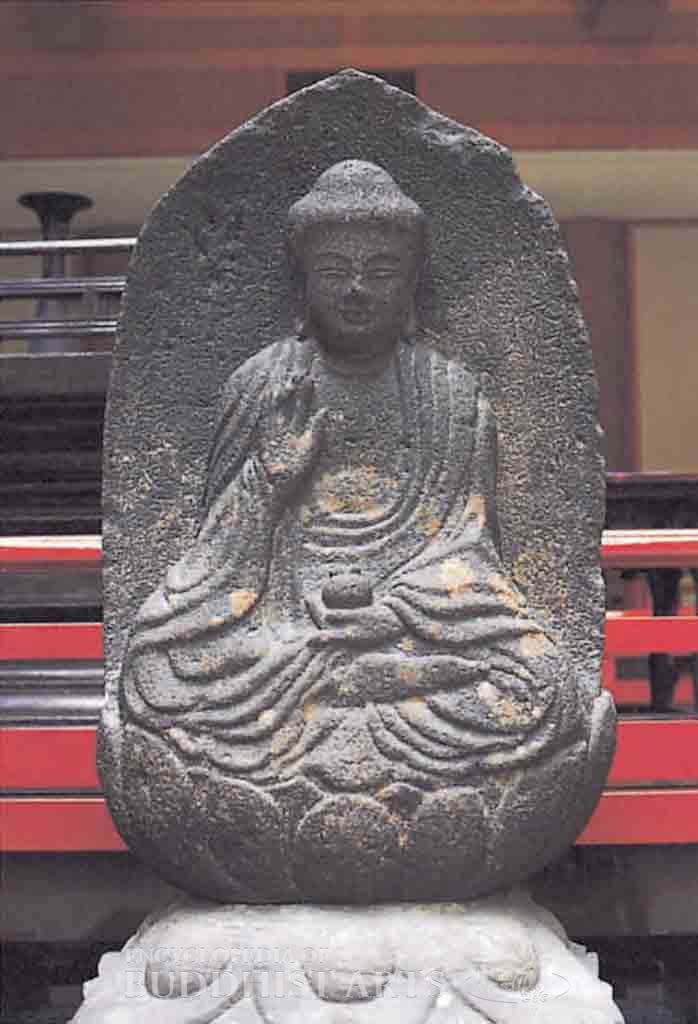
Kuhonji Temple: Medicine Buddha
Andesite
Kuhonji Temple: Medicine Buddha
JAPAN, Kanagawa, Kamakura; Kamakura period
According to the accompanying inscription on the back, the statue was carved in 1296. It is cut from a single stone and includes the petal-shaped mandorla rising from a lotus pedestal. The Buddha is carved out of the mandorla in high relief. The inverted lotus pedestal on which the composition is mounted is a later addition.
The figure is clothed in monastic robes with carefully delineated folds, in contrast to the simplified treatment of the face. Seated in half lotus position with the right hand raised in abhaya (fearlessness) mudra, the Buddha holds a bowl in the left hand.
For more details, go to the Encyclopedia of Buddhist Arts: Sculpture G-M, page 566.
Cite this article:
Hsingyun, et al. "Kuhonji Temple: Medicine Buddha." Encyclopedia of Buddhist Arts: Sculpture G-M, vol. 11, 2016, pp. 566.
Hsingyun, Youheng, Yann Lovelock, Yuan Chou, Susan Huntington, Gary Edson, and Robert Neather. 2016. "Kuhonji Temple: Medicine Buddha" In Encyclopedia of Buddhist Arts: Sculpture G-M, 11:566.
Hsingyun, Youheng, Lovelock, Y., Chou, Y., Huntington, S., Edson, G., & Neather, R.. (2016). Kuhonji Temple: Medicine Buddha. In Encyclopedia of Buddhist Arts: Sculpture G-M (Vol. 11, pp. 566).
@misc{Hsingyun2016,
author = Hsingyun and Youheng and Lovelock, Yann and Chou, Yuan and Huntington, Susan and Edson, Gary and Neather, Robert,
booktitle = {Encyclopedia of Buddhist Arts: Sculpture G-M},
pages = 566,
title = {{Kuhonji Temple: Medicine Buddha}},
volume = 11,
year = {2016}}
author = Hsingyun and Youheng and Lovelock, Yann and Chou, Yuan and Huntington, Susan and Edson, Gary and Neather, Robert,
booktitle = {Encyclopedia of Buddhist Arts: Sculpture G-M},
pages = 566,
title = {{Kuhonji Temple: Medicine Buddha}},
volume = 11,
year = {2016}}