
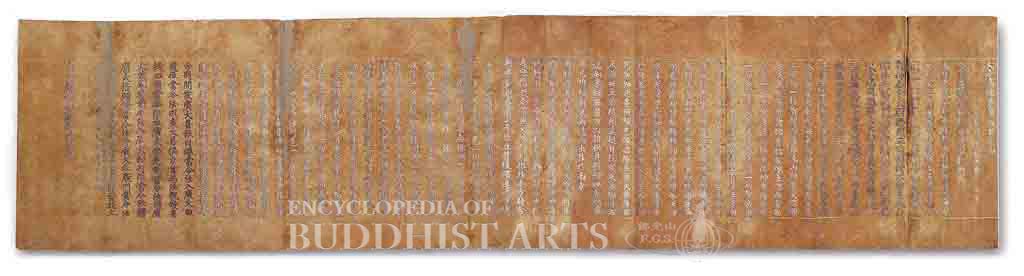
Avatamsaka Sutra - Fascicle 4 (detail)
Gold and silver on paper
Avatamsaka Sutra
KOREA; Goryeo dynasty
The Avatamsaka Sutra was translated into Chinese in the 80-fascicle, 60-fascicle, and the 40-fascicle versions. This manuscript uses the 40-fascicle version, which was translated by Tripitaka Master Prajna during Tang dynasty (618–907). This version is also known by other titles, one of which is the “Chapter on the Practices and Vows of Samantabhadra.” Each page of this accordion-fold manuscript measures 30.9 cm high and 12.3 cm wide. It was thought to date from the 14th century, and was listed as Treasure No. 1137 in 2003.
In this manuscript, the titles are written in gold, while the main text is in silver. The orderly formatting, stylistically articulated brushwork, and perceptibly spacious character structure suggest that it was modeled after the style of Tang dynasty calligrapher, Yan Zhenqing. Bold, resolute strokes that represent Yan’s character forms appear subtle in tone and simple in expression. The overall style conveys an approachable mood, and is an interesting aspect identified within the composition of this sutra transcription.
For more details, go to the Encyclopedia of Buddhist Arts: Calligraphy, page 13.
Cite this article:
author = Hsingyun and Youheng and Youlu and Pokorski, Stefanie and Mankuang and Edson, Gary,
booktitle = {Encyclopedia of Buddhist Arts: Calligraphy },
pages = 13,
title = {{Avatamsaka Sutra}},
volume = 17,
year = {2016}}