
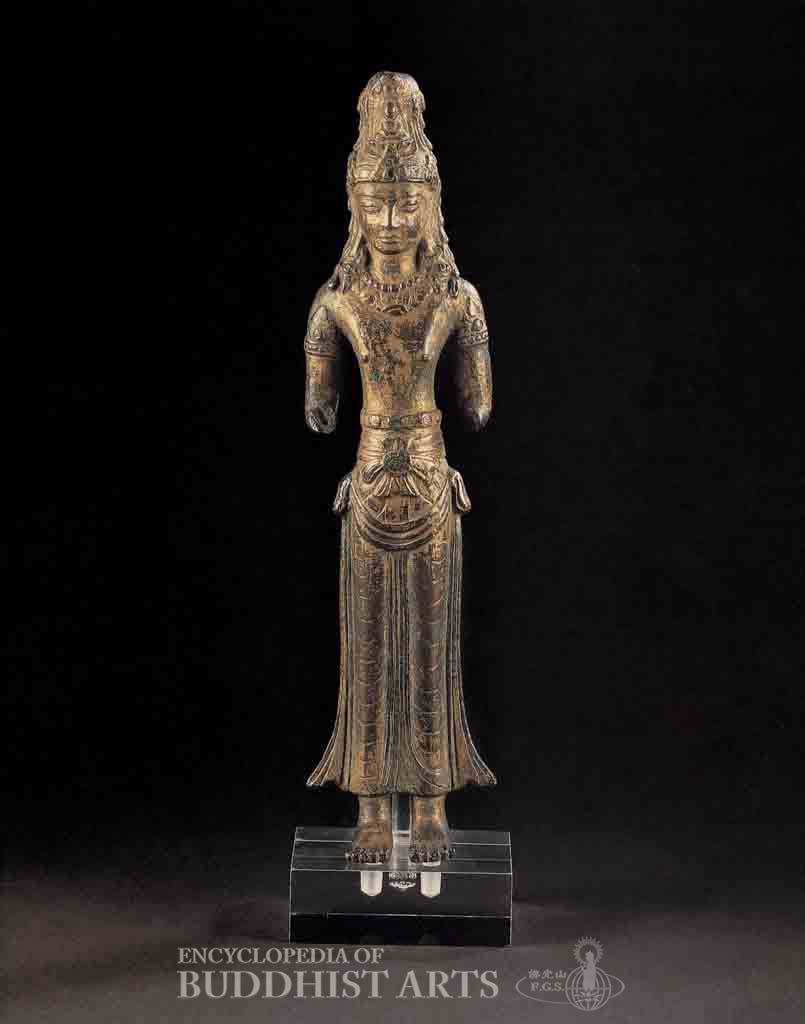
Ajaya Avalokitesvara
Gilt bronze
Ajaya Avalokitesvara
CHINA; Song dynasty
This type of figure is known as Ajaya Avalokitesvara or All-Conquering Avalokitesvara according to the Illustrated History of the Nanzhao Kingdom. It was popular during the time of the Dali Kingdom (937–1253). An Indian monk teaching Dharma to the local people in the region of Erhai, Yunnan, was believed to a manifestation of Ajaya Avalokitesvara.
The sculpture has a high topknot secured by a headdress that includes a seated Buddha. Hair falls to the shoulders and piles about the elongated earlobes. The body is stylistically thin and adorned with jewelry. A long skirt hugs the legs and is knotted with a sash at the waist. The statue is of mixed style, combining influences from India, Nepal, Tibet, and Myanmar.
For more details, go to the Encyclopedia of Buddhist Arts: Sculpture A-F, page 4.
Cite this article:
author = Hsingyun and Youheng and Lovelock, Yann and Chou, Yuan and Huntington, Susan and Edson, Gary and Neather, Robert,
booktitle = {Encyclopedia of Buddhist Arts: Sculpture A-F},
pages = 4,
title = {{Ajaya Avalokitesvara}},
volume = 10,
year = {2016}}