
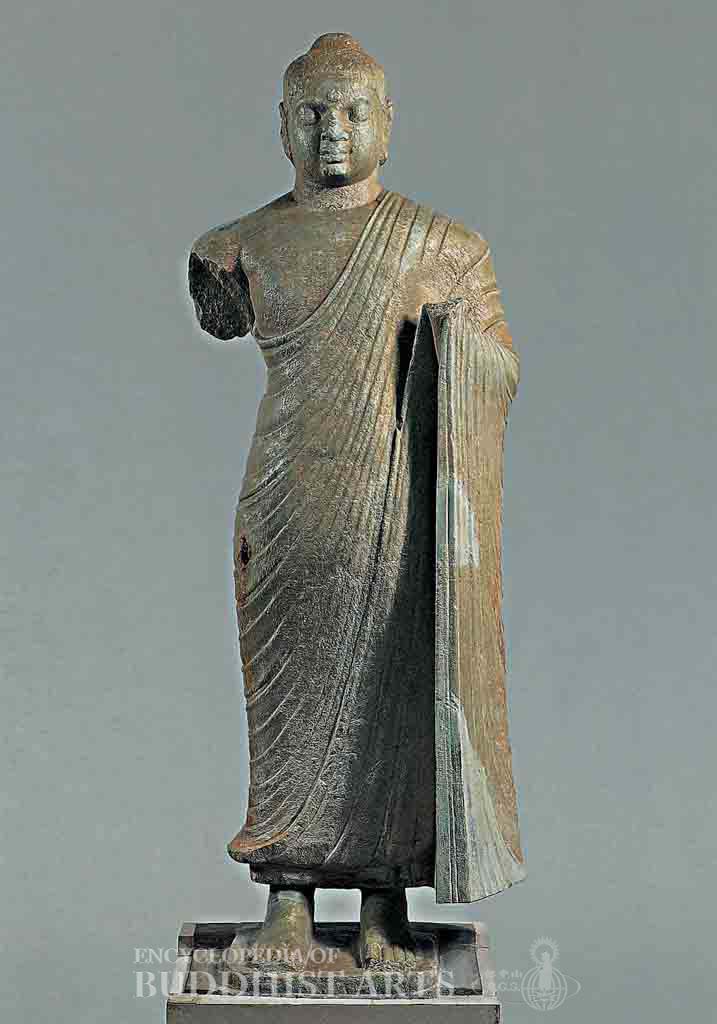
Amaravati: Standing Buddha
Limestone
Amaravati: Standing Buddha
INDIA, Andhra Pradesh, Amaravati; Satavahana period
Although Amaravati is comparable to regions such as Gandhara and Mathura as a center for the production of ancient Buddhist artifacts, the figure shown is one of the few freestanding statues of the Buddha to be discovered here.
Some of the Thirty-Two Marks of Excellence are depicted in this example, including curled hair building to a flattened usnisa and an urna. The earlobes are not noticeably lengthened and the neck lacks the three lines. The face has south Indian features, notably a broad nose and a full-lipped mouth that is not much broader. The figure wears a heavy monastic robe that leaves the right shoulder bare. That arm is raised and the hand most probably once tightened the fold of the robe about the forearm, as in other statues of the period.
For more details, go to the Encyclopedia of Buddhist Arts: Sculpture A-F, page 26.
Cite this article:
author = Hsingyun and Youheng and Lovelock, Yann and Chou, Yuan and Huntington, Susan and Edson, Gary and Neather, Robert,
booktitle = {Encyclopedia of Buddhist Arts: Sculpture A-F},
pages = 26,
title = {{Amaravati: Standing Buddha}},
volume = 10,
year = {2016}}