
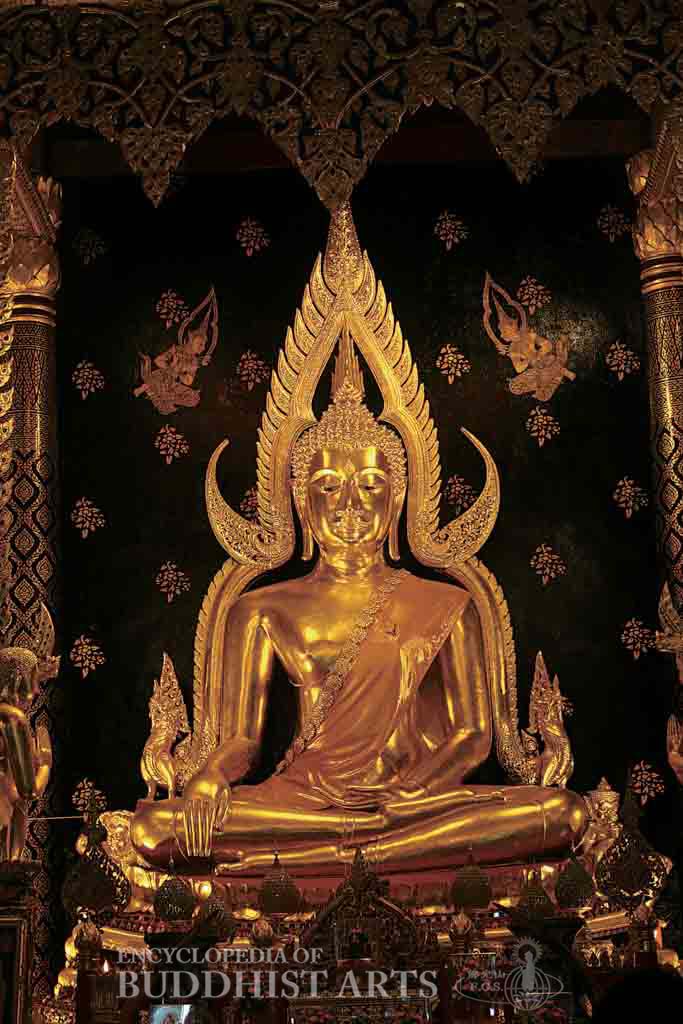
Wat Phra Sri Rattana Mahathat Main Hall: Phra Buddha Chinnarat
Gilt copper alloy
Wat Phra Sri Rattana Mahathat Main Hall: Phra Buddha Chinnarat
THAILAND, Phitsanulok
The statue is considered one of the most beautiful Buddhas created during the Sukhothai Kingdom (circa 1238–1438). It is believed that the statue was created under order of King Phaya Lithai (reigned circa 1346–1368). There are four specific styles from the early Sukhothai Kingdom, with one of them being called “Chinnarat,” specially taken after this statue.
Other stylistic references include the flame ornament on the usnisa, long elegant fingers of equal length, toes of equal length on flattened feet, and the extended thighs that creates a sense of triangular balance.
The figure sits in half lotus position with the right hand in bhumisparsa (earth-touching) mudra. An aureole is created by the serrated tails of dragons mounted on either side of the figure’s leg, while a nimbus continues on from the dragons’ tails, whose edges are decorated with stylized flames. Heavenly beings are visible at the Buddha’s knees.
For more details, go to the Encyclopedia of Buddhist Arts: Sculpture St-Z, page 1329.
Cite this article:
author = Hsingyun and Youheng and Lovelock, Yann and Chou, Yuan and Huntington, Susan and Edson, Gary and Neather, Robert,
booktitle = {Encyclopedia of Buddhist Arts: Sculpture St-Z},
pages = 1329,
title = {{Wat Phra Sri Rattana Mahathat Main Hall: Phra Buddha Chinnarat}},
volume = 13,
year = {2016}}