
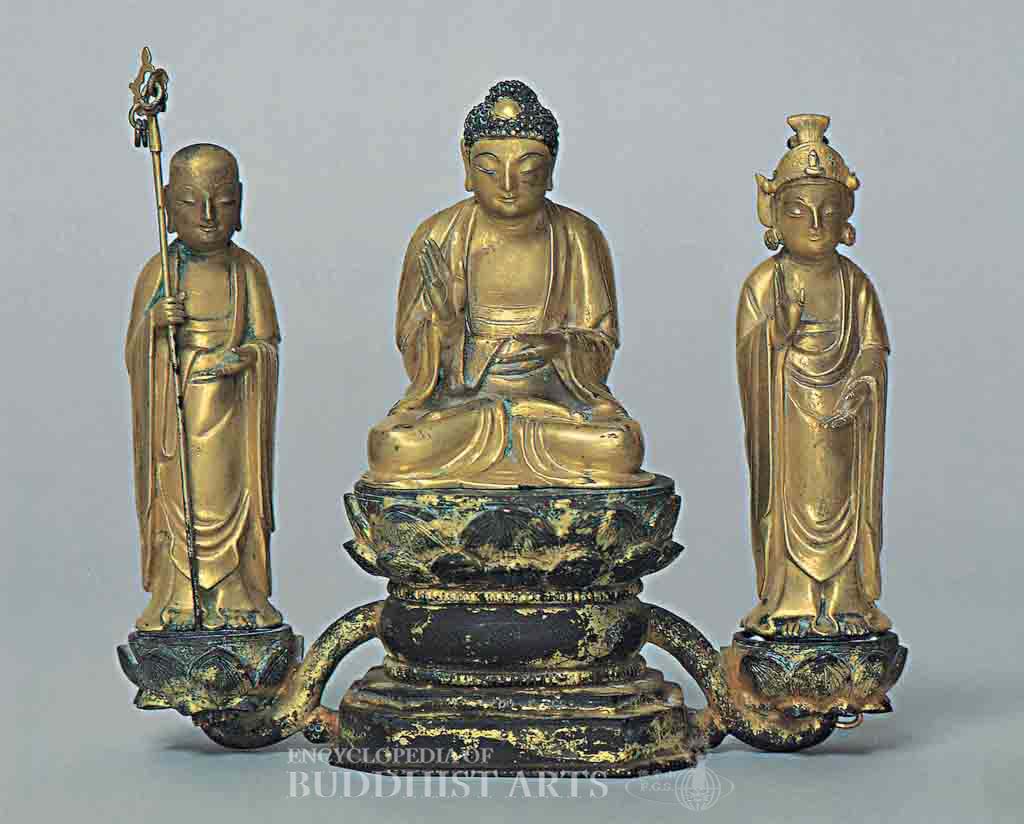
Amitabha Buddha Triad
Gilt bronze
Amitabha Buddha Triad
KOREA; Joseon dynasty
The triad was probably discovered in Kumgangsan, Gangwon. Amitabha sits in full lotus position on a lotus throne. Two lotuses bloom from the sides of the throne to serve as pedestals for the accompanying Bodhisattvas. This style is similar to stone statues from the Chinese Northern Wei dynasty (386–534) and the gilt bronze statues of the Sui dynasty (581–618). The Buddha’s monastic robe covers both shoulders and the right hand is raised in abhaya (fearlessness) mudra. Avalokitesvara, on the right, is making the same mudra and dressed in similar robes. The figure wears a crown but no other jewelry, which is unusual. Ksitigarbha, on the left, has a shaved head and carries a warning staff.
For more details, go to the Encyclopedia of Buddhist Arts: Sculpture A-F, page 37.
Cite this article:
author = Hsingyun and Youheng and Lovelock, Yann and Chou, Yuan and Huntington, Susan and Edson, Gary and Neather, Robert,
booktitle = {Encyclopedia of Buddhist Arts: Sculpture A-F},
pages = 37,
title = {{Amitabha Buddha Triad}},
volume = 10,
year = {2016}}