
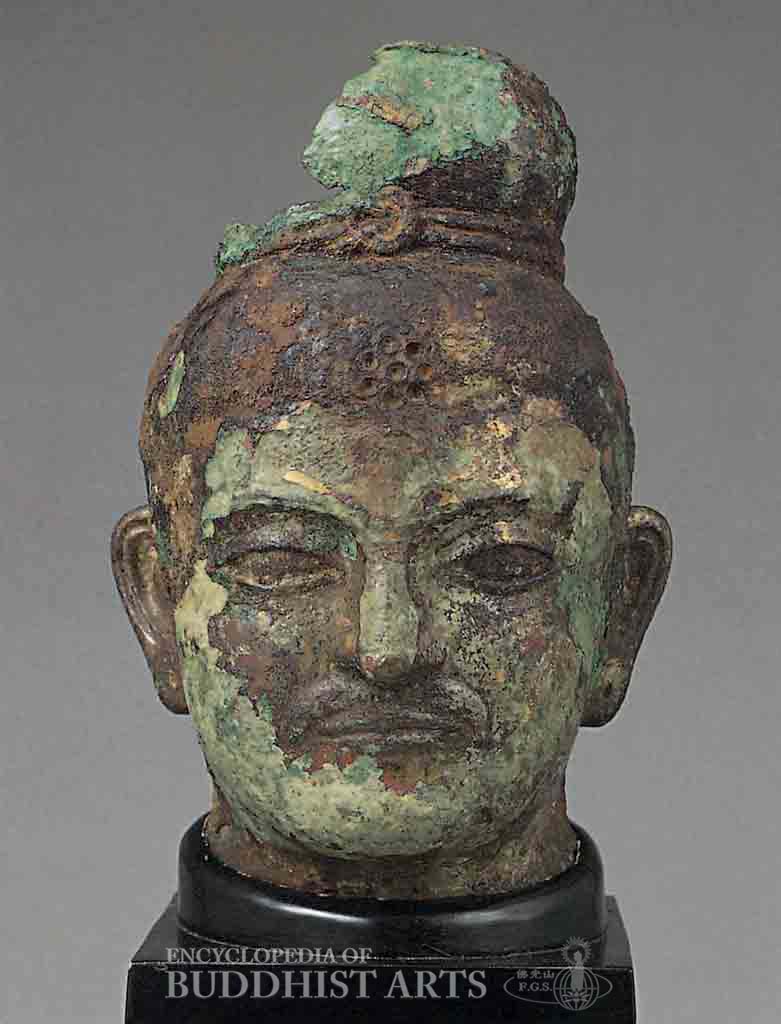
Yotkan: Head of a Buddha
Gilt bronze
Yotkan: Head of a Buddha
CHINA, Xinjiang, Hotan
This sculpture was discovered at Yotkan in Hotan during the Japanese Otani expeditions that took place between 1902 and 1910. The Buddha’s usnisa is treated like a topknot shaped by a buckled tie. Damage to the back of the head has revealed that the statue had an interior cavity, which may have been used to store relics. The forehead has been stamped with a lotus design, either in place of an urna or perhaps as a jewel fronting the drawn back hair. The face still bears traces of red paint and gilding, and is lightly mustached. The bottom of the neck has been blocked off, revealing that the head was cast separately from the body.
For more details, go to the Encyclopedia of Buddhist Arts: Sculpture St-Z, page 1423.
Cite this article:
Hsingyun, et al. "Yotkan: Head of a Buddha." Encyclopedia of Buddhist Arts: Sculpture St-Z, vol. 13, 2016, pp. 1423.
Hsingyun, Youheng, Yann Lovelock, Yuan Chou, Susan Huntington, Gary Edson, and Robert Neather. 2016. "Yotkan: Head of a Buddha" In Encyclopedia of Buddhist Arts: Sculpture St-Z, 13:1423.
Hsingyun, Youheng, Lovelock, Y., Chou, Y., Huntington, S., Edson, G., & Neather, R.. (2016). Yotkan: Head of a Buddha. In Encyclopedia of Buddhist Arts: Sculpture St-Z (Vol. 13, pp. 1423).
@misc{Hsingyun2016,
author = Hsingyun and Youheng and Lovelock, Yann and Chou, Yuan and Huntington, Susan and Edson, Gary and Neather, Robert,
booktitle = {Encyclopedia of Buddhist Arts: Sculpture St-Z},
pages = 1423,
title = {{Yotkan: Head of a Buddha}},
volume = 13,
year = {2016}}
author = Hsingyun and Youheng and Lovelock, Yann and Chou, Yuan and Huntington, Susan and Edson, Gary and Neather, Robert,
booktitle = {Encyclopedia of Buddhist Arts: Sculpture St-Z},
pages = 1423,
title = {{Yotkan: Head of a Buddha}},
volume = 13,
year = {2016}}