
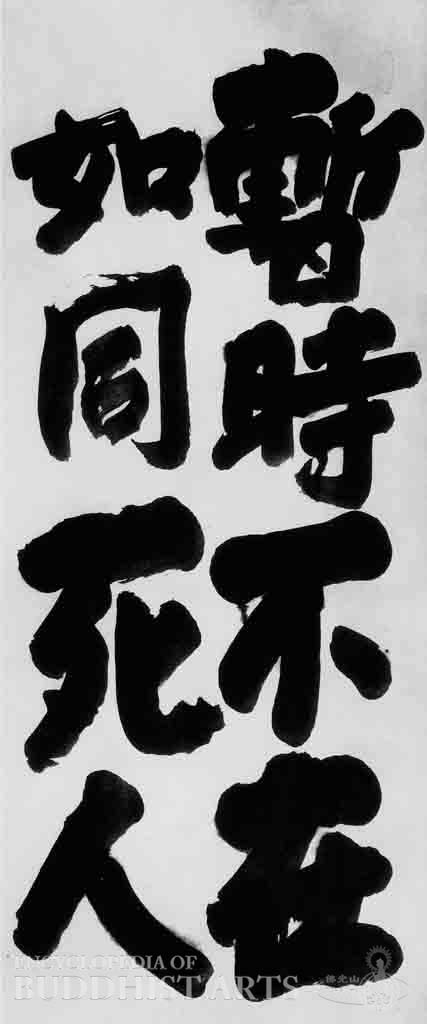
Dialogue Between Masters Tansheng and Weishan
Ink on paper
Dialogue Between Masters Tansheng and Weishan
JAPAN; Edo period
This piece was written during the later years of Zen Master Hakuin Ekaku. It records a paradoxical dialogue between Chan Masters Tansheng and Weishan, in which Weishan asked, “What is it like during temporary absence?” To which Tansheng replied, “It is akin to being buried.” Simply put, if one has no awareness, it is no different from being dead; conversely, people who realize the truth are alive with senses, and are not subjected to a callous nature such as that of wood or stone.
The calligraphy as a whole is written with round, thick, and stable strokes. The close proximity between the two lines of characters gives the piece an active and energetic vibe. Ink flows without stagnation, and the brushwork is swift with ease and verve. It is a work that has the momentum of Chan philosophy.
Hakuin Ekaku was a Zen master of the Rinzai school during the mid-Edo period (1615–1868). Reputed as the originator of the Rinzai school in Japan, he had no desire for fame and wealth. Master Hakuin traveled often and dedicated his life to systematizing koans, which are Zen Buddhist stories, statements, or questions, like the one above, that are of a contradictory nature and one is to meditate upon in order to achieve a certain level of intuitive clarity or enlightenment.
For more details, go to the Encyclopedia of Buddhist Arts: Calligraphy, page 48.
Cite this article:
author = Hsingyun and Youheng and Youlu and Pokorski, Stefanie and Mankuang and Edson, Gary,
booktitle = {Encyclopedia of Buddhist Arts: Calligraphy },
pages = 48,
title = {{Dialogue Between Masters Tansheng and Weishan}},
volume = 17,
year = {2016}}