
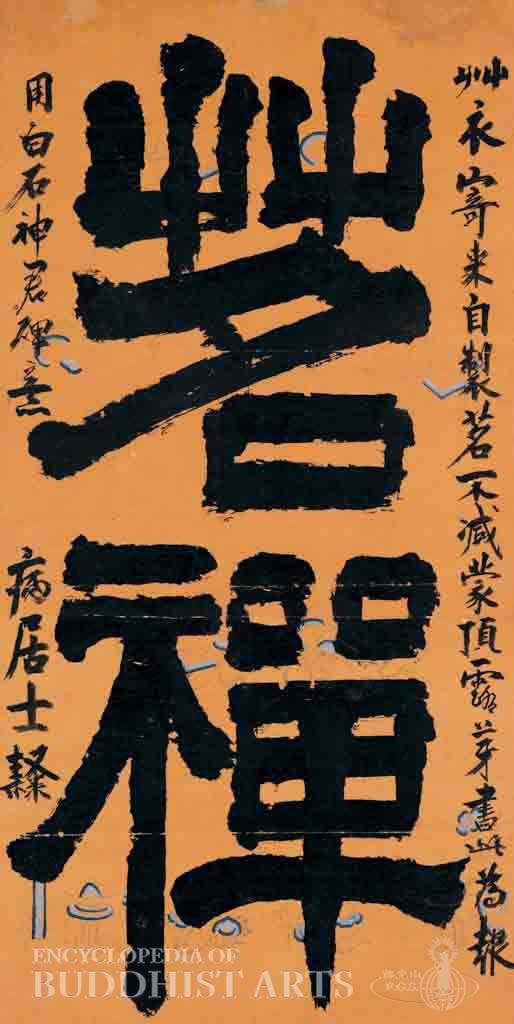
Characters - Tea Meditation
Ink on paper
Characters - Tea Meditation
KOREA; Joseon dynasty
This calligraphy was written by Kim Jeonghui for his good friend, Chan Master Caoyi Yixun, who had sent him a gift of tea leaves. The scroll is comprised of two Chinese words, “ming” (tea) and “Chan” (meditation). Together, the two words imply entering into deep meditation with the addition of tea to invoke a sense of radiance and beauty.
Kim Jeonghui felt strongly that any person who was interested in calligraphy should learn and understand clerical script. The characters of this scroll are written in flat, straight strokes that appear simple and bold without fanciful curves or endings. The overall composition creates an intriguing and forceful work of art.
Kim Jeonghui, also known as Wonchun or Chusa, was a calligrapher, painter, seal engraver, and poet. His style, known as Chusa style, is considered vigorous and energetic.
For more details, go to the Encyclopedia of Buddhist Arts: Calligraphy, page 30.
Cite this article:
author = Hsingyun and Youheng and Youlu and Pokorski, Stefanie and Mankuang and Edson, Gary,
booktitle = {Encyclopedia of Buddhist Arts: Calligraphy },
pages = 30,
title = {{Characters - Tea Meditation}},
volume = 17,
year = {2016}}