
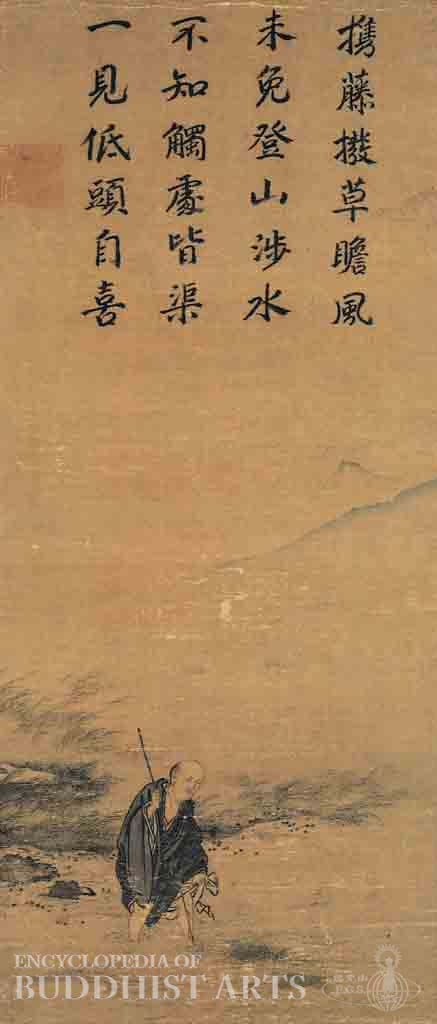
Annotated Painting - Master Dongshan Wading the Stream
Ink on silk
Annotated Painting - Master Dongshan Wading the Stream
CHINA; Southern Song dynasty
It is said that Dongshan Liangjie, the founding patriarch of the Caodong school of Chan Buddhism, achieved enlightenment upon seeing his reflection in the water. He penned the following verse after the profound experience:
“There is no searching for him outside, lest he move far, far away;
Now that I go my way alone, I meet him everywhere;
Now he is exactly me, but I am not now he;
Understanding should be this way, in accordance with True Suchness.”
This verse served as the inspiration for this painting by Ma Yun, as well as the inscription by Empress Yang Meizi. The inscription references Dongshan’s journey in seeking enlightenment; traversing mountains and waterways, only to discover after enlightenment, that the way is everywhere.
Known to be talented in poetry, calligraphy, and painting, Yang was the empress of Emperor Ningzong (reigned 1194–1224). Her calligraphic style is akin to the imperial calligraphic style that was in place since the rule of Emperor Gaozong (reigned 1127–1162). Her own unadorned brushwork, however, also contained traces of Yan Zhenqing’s style. This scroll is one of the three surviving depictions of Five Patriarchs of the Chan School, all of which feature similar inscriptions by Yang.
For more details, go to the Encyclopedia of Buddhist Arts: Calligraphy, page 9.
Cite this article:
author = Hsingyun and Youheng and Youlu and Pokorski, Stefanie and Mankuang and Edson, Gary,
booktitle = {Encyclopedia of Buddhist Arts: Calligraphy },
pages = 9,
title = {{Annotated Painting - Master Dongshan Wading the Stream}},
volume = 17,
year = {2016}}