
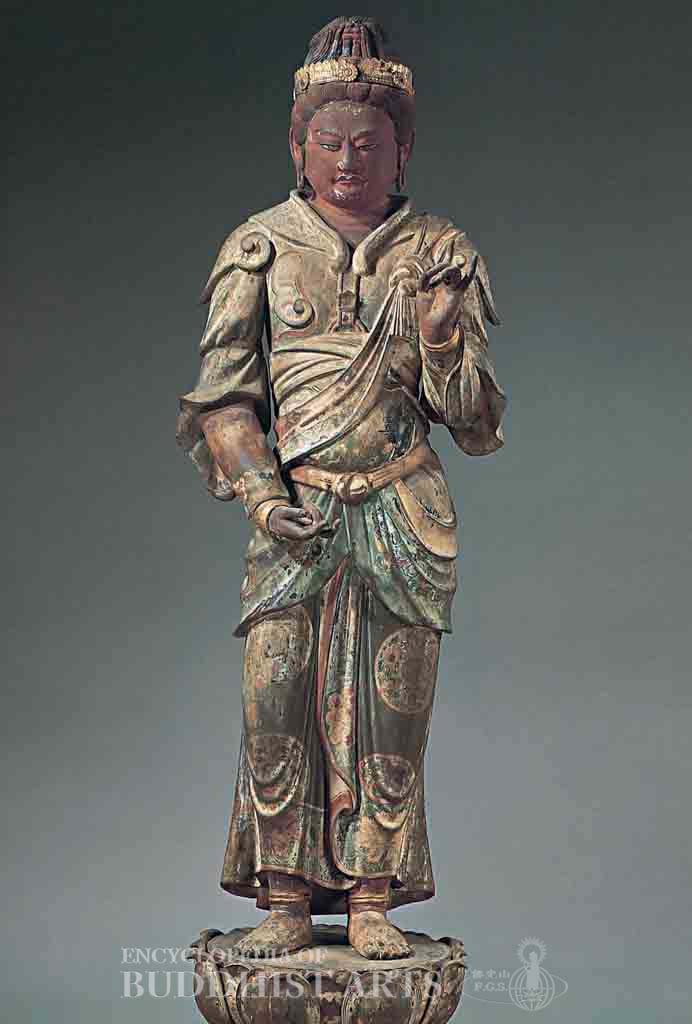
Akishinodera Temple: Brahma
Dry lacquer wood
Akishinodera Temple: Brahma
JAPAN, Nara; Nara period
The statue dates to the late Nara period (710–794), and was the work of local sculptors. It was assembled from carved pieces of cypress with details added later in dry lacquer. An ink inscription, discovered in 1936 on the inside, records the carving was repaired in 1289.The work is listed as an Important Cultural Property.
The Brahma’s bluish hair is piled high and bound with a chrysanthemum fillet. The face has a resolute and dignified expression. The waist is slightly twisted to one side, shifting the balance of the body onto the left foot. The figure looks down commandingly with the left hand raised in the karana (warding off evil) mudra, and the right hand lowered in a mudra. A breastplate is worn over a belted tunic, and the folds and patterns of the colorful skirt beneath are skillfully portrayed.
For more details, go to the Encyclopedia of Buddhist Arts: Sculpture A-F, page 8.
Cite this article:
author = Hsingyun and Youheng and Lovelock, Yann and Chou, Yuan and Huntington, Susan and Edson, Gary and Neather, Robert,
booktitle = {Encyclopedia of Buddhist Arts: Sculpture A-F},
pages = 8,
title = {{Akishinodera Temple: Brahma}},
volume = 10,
year = {2016}}