
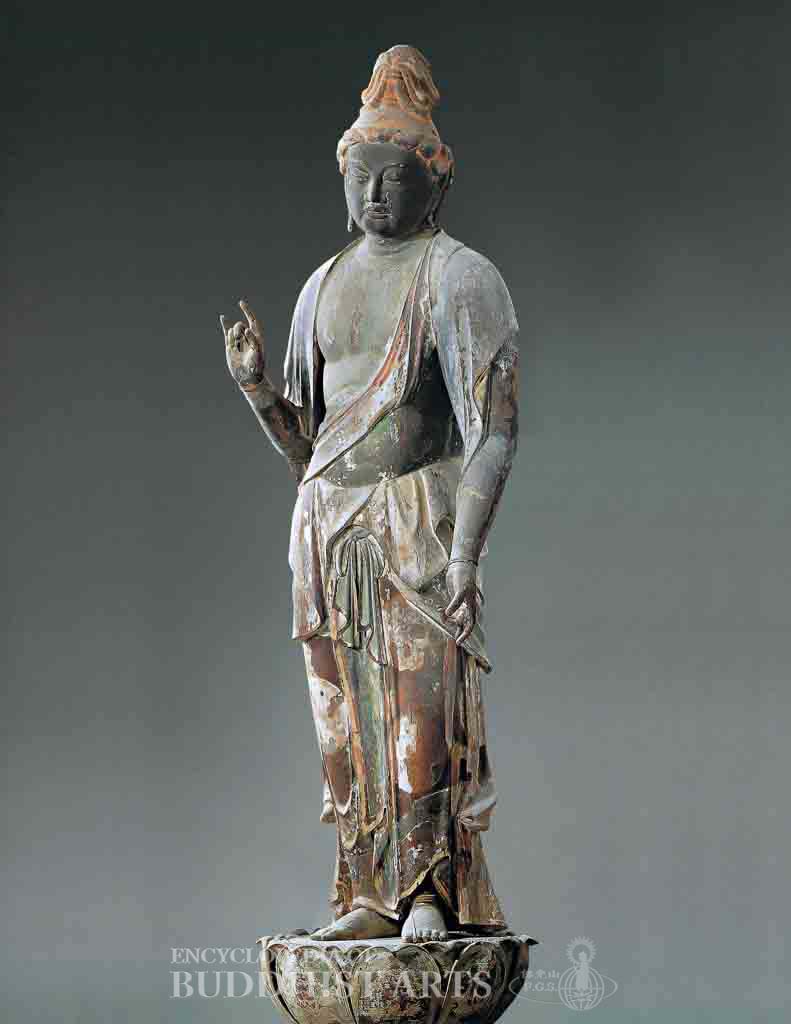
Akishinodera Temple: Heavenly Being
Dry lacquer wood
Akishinodera Temple: Heavenly Being
JAPAN, Nara; Nara period
The original name for this sculpture is unknown, but since the figure’s head is inclined to one side as though listening to music, it was given the name “Gigeiten” in the Meiji period (1868–1912). The name means heavenly being of the performing arts. It is listed as an Important Cultural Property.
The head was created first, during the late Nara period (710–794), by the hollow dry lacquer method and added to the body in 1289. The body was assembled from pieces of cypress and then painted. The figure’s hair is tied into an elaborate topknot. The mouth is slightly open in the full face while the expression is peaceful. Both hands are in the karana (warding off evil) mudra. Stoles are worn over the upper body and the skirt is depicted with many layers of folds. The whole body is slightly inclined to one side and the right foot is advanced. Although the head and the body are made from different materials and are from different periods, they achieve a unity.
For more details, go to the Encyclopedia of Buddhist Arts: Sculpture A-F, page 8.
Cite this article:
author = Hsingyun and Youheng and Lovelock, Yann and Chou, Yuan and Huntington, Susan and Edson, Gary and Neather, Robert,
booktitle = {Encyclopedia of Buddhist Arts: Sculpture A-F},
pages = 8,
title = {{Akishinodera Temple: Heavenly Being}},
volume = 10,
year = {2016}}