
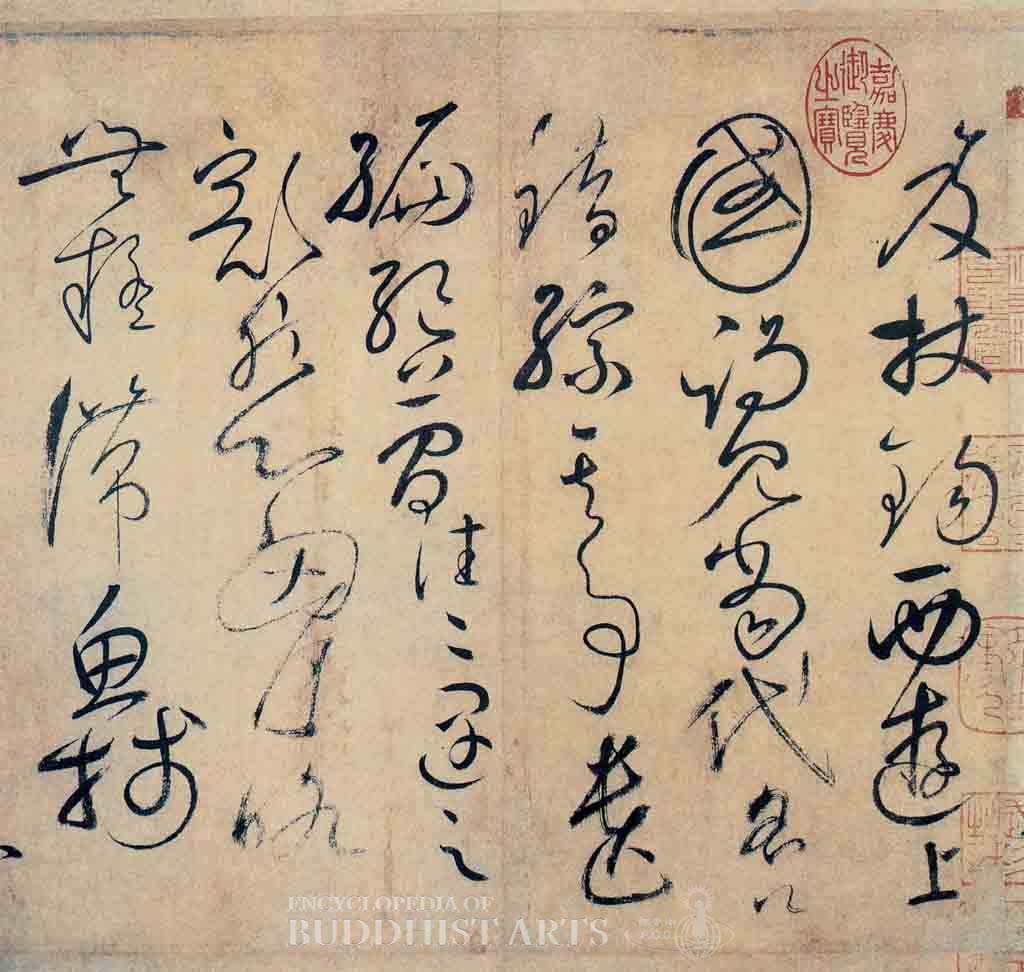
Autobiography of Huaisu (detail)
Ink on paper
Autobiography of Huaisu
CHINA; Tang dynasty
This piece, containing 698 characters in 126 columns, was written by monk Huaisu at the age of 40. In the note, he provides an autobiographical narration of his experience learning calligraphy, as well as the way in which his works were praised and criticized. Postscripts at the end are written by Song dynasty (960–1279) poet, Su Zhe, and Ming dynasty (1368–1644) scholar, Li Dongyang. The piece offers a glimpse of the unrestrained cursive script in which Huaisu excelled and for which he was renowned.
This structured work of calligraphy is composed of scattered characters that vary in size. Each character was written in center tip and comprised of thin, sturdy strokes that appear distinguished and lively. Scripted with rapid speed, the ink was applied thick and appears dried in certain characters. The mood of the piece follows the state of content of the calligrapher, from an apparent level of equanimity to a realm of ecstasy; the first half of the composition features strokes that are smooth and free, while the second half becomes wild with brushstroke that are swift and powerful like a storm. Xuanhe Catalog of Calligraphy commented on this piece, stating that “every character flies with exquisite tactfulness; it is a work of divinity.”
Huaisu’s family name was Qian and he was also known as Cangzhen. He was a calligrapher and Buddhist monk of the Tang dynasty (618–907). Having renounced at a young age, he diligently studied Buddhist sutras and meditation, but later became enthusiastically engaged in the arts. His vigorous writing style was similar to that of Zhang Xu, and together they were referred to as Wild Zhang and Crazy Su.
For more details, go to the Encyclopedia of Buddhist Arts: Calligraphy, page 10.
Cite this article:
author = Hsingyun and Youheng and Youlu and Pokorski, Stefanie and Mankuang and Edson, Gary,
booktitle = {Encyclopedia of Buddhist Arts: Calligraphy },
pages = 10,
title = {{Autobiography of Huaisu}},
volume = 17,
year = {2016}}