
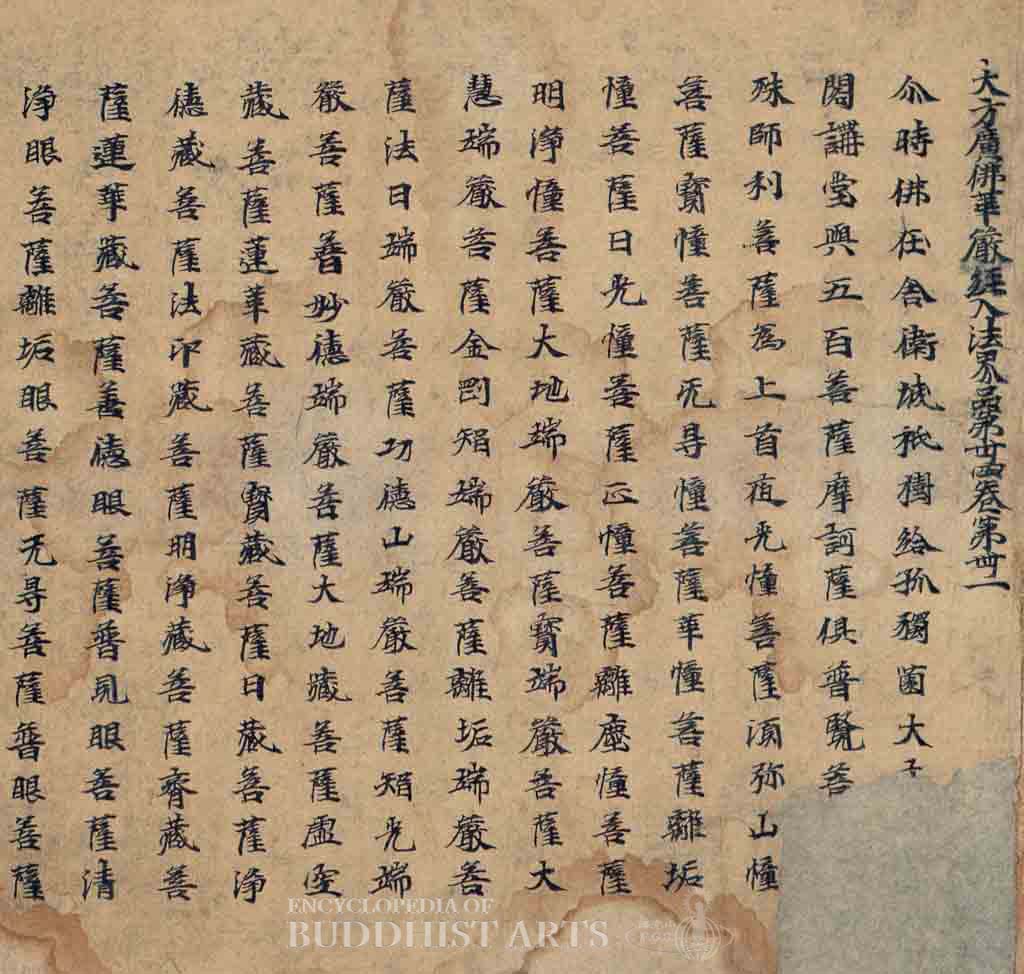
Avatamsaka Sutra - Fascicle 41 (right end section)
Ink on paper
Avatamsaka Sutra - Fascicle 41
CHINA; Northern Wei dynasty
This sutra manuscript from the Northern Wei dynasty (386–534) is considered particularly rare due to the scarcity of works recorded with names and dating from the Northern Dynasties (386–581). A postscript at the end of the scroll identifies the calligrapher as Cao Fashou, a sutra copyist from Dunhuang, and the date as 513.
The majority of sutra manuscripts from the Northern Dynasties were found in Mogao Cave 17 in Dunhuang. While traces of clerical script remain evident, these sutras were largely written in regular script. The characters are arranged neatly and symmetrically, and the strokes are written with elegance and vigor. Each stroke is executed with the fineness of the brush tip, and finished with a broad end. Linear strokes are drawn out fluently and naturally. Subtle signs of clerical script remain discernible in the diagonal strokes, which are a representative feature of regular character forms that have evolved from clerical script. The overall style contrasts significantly with the bold and robust quality of Northern Wei steles.
For more details, go to the Encyclopedia of Buddhist Arts: Calligraphy, page 15.
Cite this article:
author = Hsingyun and Youheng and Youlu and Pokorski, Stefanie and Mankuang and Edson, Gary,
booktitle = {Encyclopedia of Buddhist Arts: Calligraphy },
pages = 15,
title = {{Avatamsaka Sutra - Fascicle 41}},
volume = 17,
year = {2016}}