
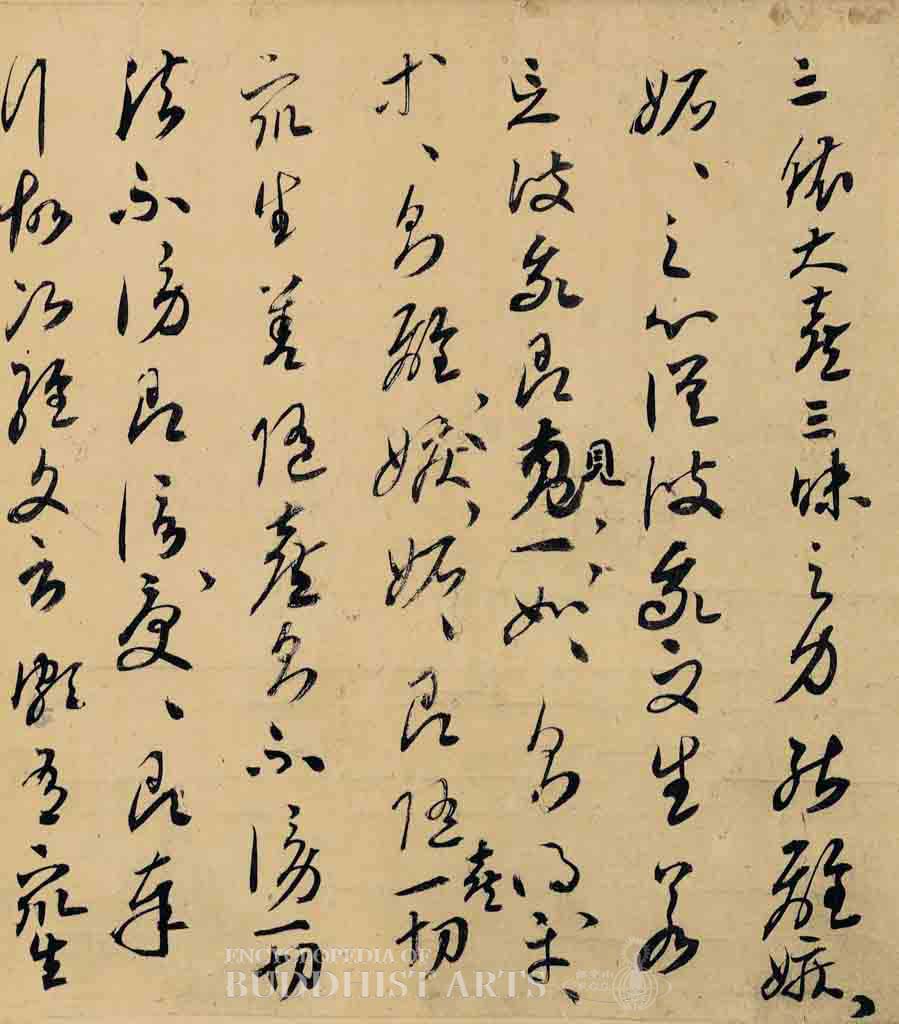
Diamond Sutra Commentary (detail)
Ink on paper
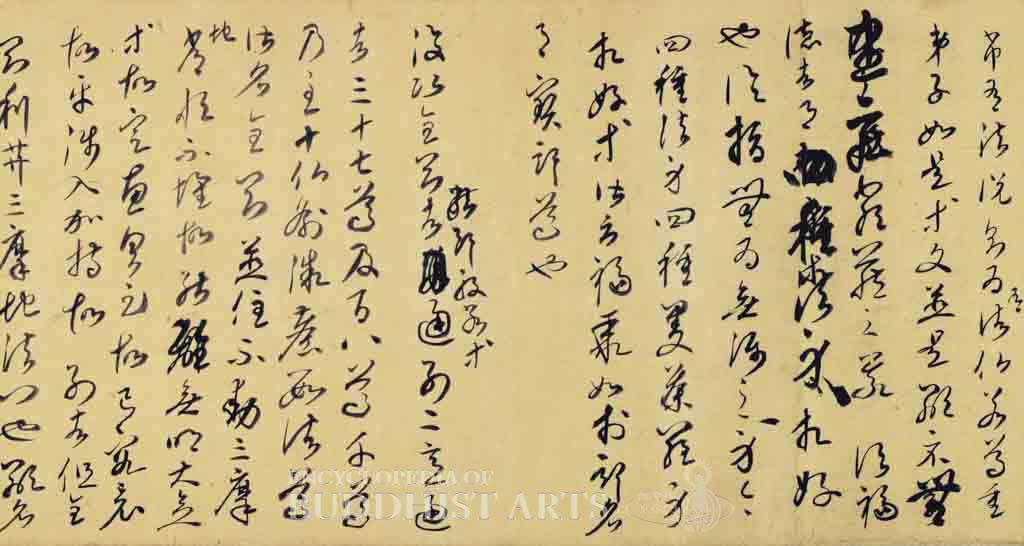
Diamond Sutra Commentary (detail)
Diamond Sutra Commentary
JAPAN; Heian period
Written by Kukai at the age of 40, this work was divided into two segments and each piece is now part of different museum collections; the 38-line segment shown here is held by the Nara National Museum, and the other segment consisting of 63 lines is kept at the Kyoto National Museum. The original work, totaling over 100 lines bound into a single fascicle, was a commentary of the Diamond Sutra from the Vajrayana Buddhist perspective. Listed as a National Treasure of Japan in 1955, this segment comprises Kukai’s word-by-word interpretation of the title, explaining the essentials of understanding the sutra.
This work appears to be a mere draft due to the presence of corrections and additions, yet the clean, firm strokes and properly formed characters demonstrate Kukai’s mastery of cursive script. The apparent stylistic influences from Wang Xizhi and Sun Guoting make this one of the representative works of Kukai’s matured calligraphic style.
A monk of the Heian Period (794–1185), Kukai was the founder of the Shingon school of Japanese Buddhism, and is known posthumously as Master Kobo. Known for his rich, varied, and unrestrained calligraphy, he was ranked alongside Emperor Saga (reigned 809–823) and Tachibana no Hayanari as one of the Three Brushes of Heian.
For more details, go to the Encyclopedia of Buddhist Arts: Calligraphy, page 60.
Cite this article:
author = Hsingyun and Youheng and Youlu and Pokorski, Stefanie and Mankuang and Edson, Gary,
booktitle = {Encyclopedia of Buddhist Arts: Calligraphy },
pages = 60,
title = {{Diamond Sutra Commentary}},
volume = 17,
year = {2016}}