
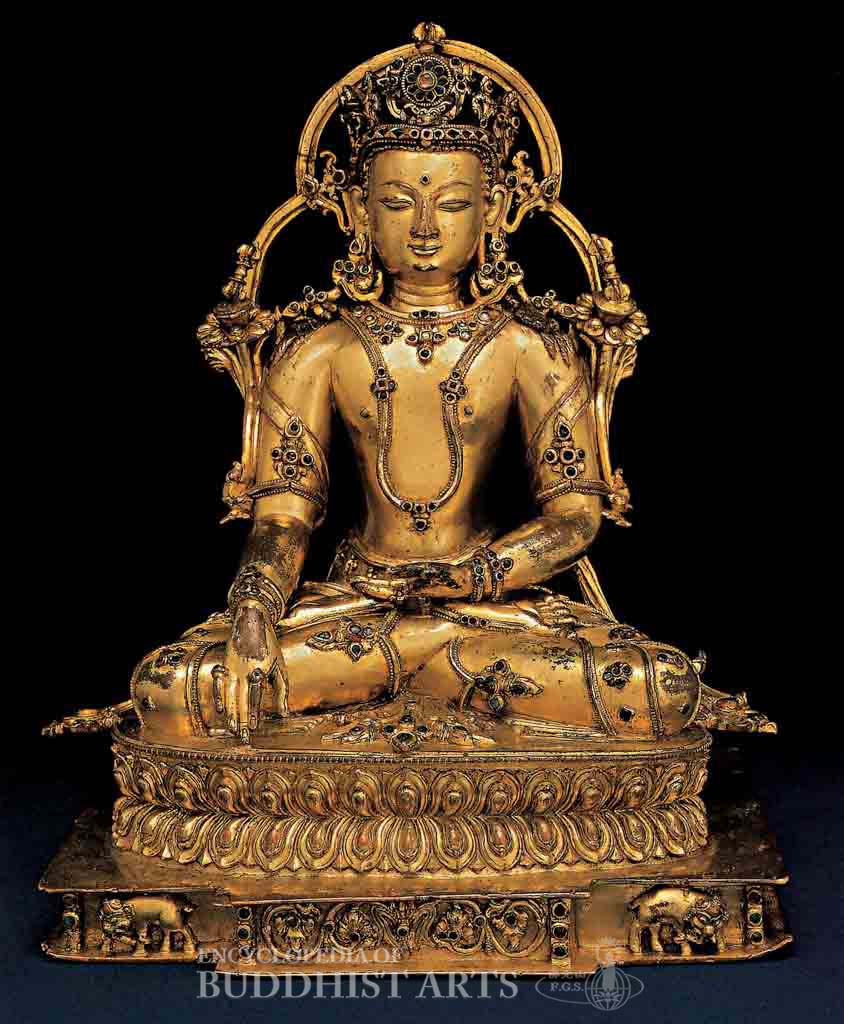
Aksobhya Buddha
Bronze inlaid with silver
Aksobhya Buddha
CHINA, Tibet; Guge Kingdom
The sculpture was cast during the 14th century of the Guge Empire (circa 10th–17th century) and displays Tibetan characteristics such as a strong upper body and tapered waist. The Buddha is seated in full lotus position on a double lotus throne with the right hand in the bhumisparsa (earth-touching) mudra. The figure is ornately decorated with a crown and numerous pieces of jewelry that have the same motif. Long-stemmed lotuses rise from behind the figure’s arms and intersect with the simple openwork nimbus at the shoulders. The platform beneath the throne is decorated with vine-like motifs and flanked by two elephants.
For more details, go to the Encyclopedia of Buddhist Arts: Sculpture A-F, page 9.
Cite this article:
Hsingyun, et al. "Aksobhya Buddha." Encyclopedia of Buddhist Arts: Sculpture A-F, vol. 10, 2016, pp. 9.
Hsingyun, Youheng, Yann Lovelock, Yuan Chou, Susan Huntington, Gary Edson, and Robert Neather. 2016. "Aksobhya Buddha" In Encyclopedia of Buddhist Arts: Sculpture A-F, 10:9.
Hsingyun, Youheng, Lovelock, Y., Chou, Y., Huntington, S., Edson, G., & Neather, R.. (2016). Aksobhya Buddha. In Encyclopedia of Buddhist Arts: Sculpture A-F (Vol. 10, pp. 9).
@misc{Hsingyun2016,
author = Hsingyun and Youheng and Lovelock, Yann and Chou, Yuan and Huntington, Susan and Edson, Gary and Neather, Robert,
booktitle = {Encyclopedia of Buddhist Arts: Sculpture A-F},
pages = 9,
title = {{Aksobhya Buddha}},
volume = 10,
year = {2016}}
author = Hsingyun and Youheng and Lovelock, Yann and Chou, Yuan and Huntington, Susan and Edson, Gary and Neather, Robert,
booktitle = {Encyclopedia of Buddhist Arts: Sculpture A-F},
pages = 9,
title = {{Aksobhya Buddha}},
volume = 10,
year = {2016}}