
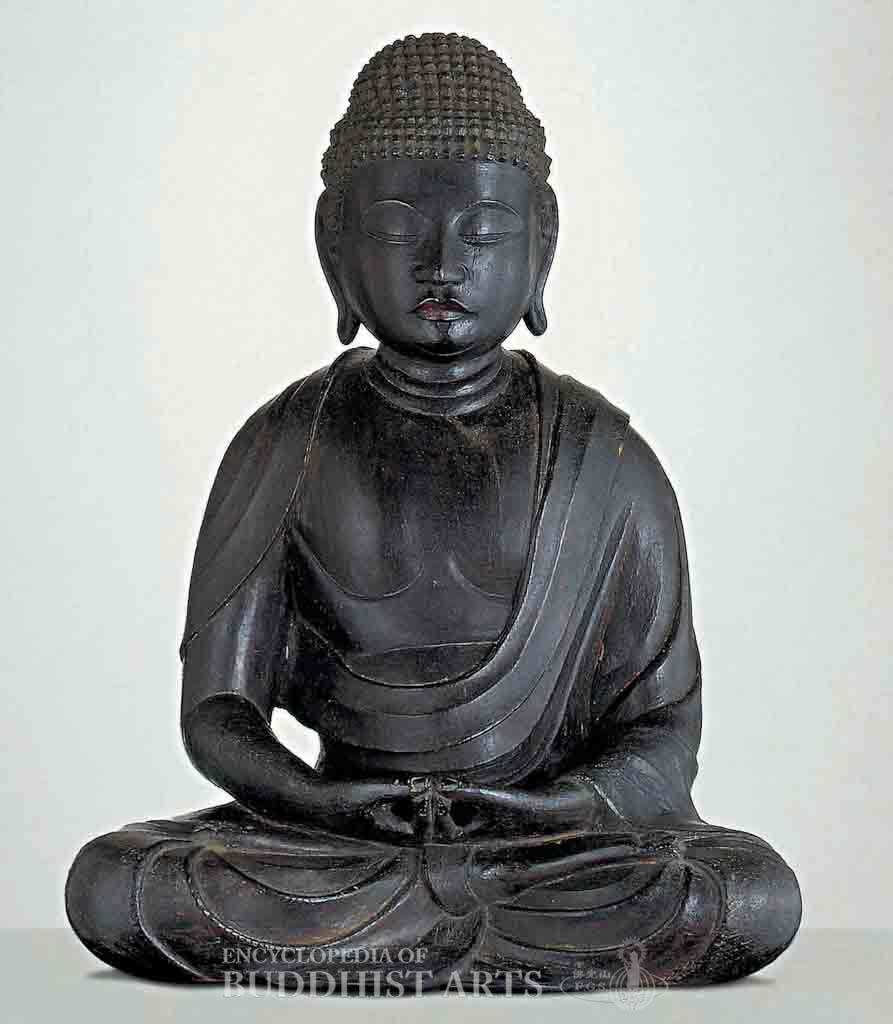
Amitabha Buddha
Wood with lacquer and gilding
Amitabha Buddha
JAPAN; Heian period
This statue from the 11th or 12th century is carved from nutmeg wood. Parts of it has been lacquered and then gilded. It is identified as Amitabha Buddha by the hands that form the highest grade of the highest class mudra associated with him. The thumbs and inward-bending index fingers of both hands touch each other to form circles. The figure’s usnisa is high and covered with well-ordered curls. The neck has the three lines characteristic of a great person. The monastic robe is simply depicted with rippling folds over the legs folded in full lotus position.
For more details, go to the Encyclopedia of Buddhist Arts: Sculpture A-F, page 31.
Cite this article:
Hsingyun, et al. "Amitabha Buddha." Encyclopedia of Buddhist Arts: Sculpture A-F, vol. 10, 2016, pp. 31.
Hsingyun, Youheng, Yann Lovelock, Yuan Chou, Susan Huntington, Gary Edson, and Robert Neather. 2016. "Amitabha Buddha" In Encyclopedia of Buddhist Arts: Sculpture A-F, 10:31.
Hsingyun, Youheng, Lovelock, Y., Chou, Y., Huntington, S., Edson, G., & Neather, R.. (2016). Amitabha Buddha. In Encyclopedia of Buddhist Arts: Sculpture A-F (Vol. 10, pp. 31).
@misc{Hsingyun2016,
author = Hsingyun and Youheng and Lovelock, Yann and Chou, Yuan and Huntington, Susan and Edson, Gary and Neather, Robert,
booktitle = {Encyclopedia of Buddhist Arts: Sculpture A-F},
pages = 31,
title = {{Amitabha Buddha}},
volume = 10,
year = {2016}}
author = Hsingyun and Youheng and Lovelock, Yann and Chou, Yuan and Huntington, Susan and Edson, Gary and Neather, Robert,
booktitle = {Encyclopedia of Buddhist Arts: Sculpture A-F},
pages = 31,
title = {{Amitabha Buddha}},
volume = 10,
year = {2016}}