
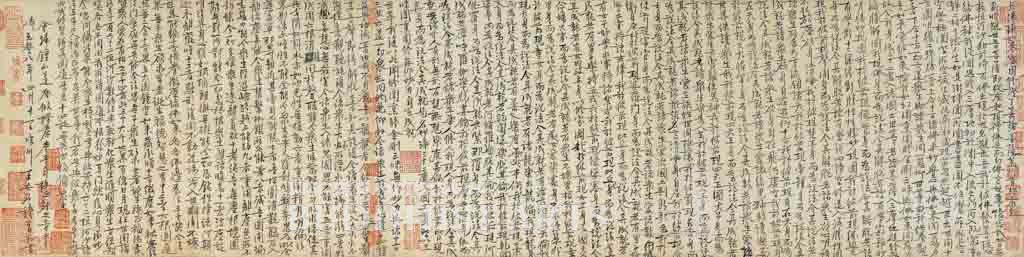
Essential Points of the Surangama Sutra
Ink on paper

Essential Points of the Surangama Sutra (detail)
Essential Points of the Surangama Sutra
CHINA; Northern Song dynasty
Wang Anshi wrote this 74-line script. The calligraphy text was inscribed on a temple during Wang’s proofreading of the Surangama Sutra at Zhongshan (Bell Mountain) according to the postscript. The writing primarily condenses the Fascicle 6 of the sutra, which ends at the part on fearlessness in the practice of name recitation. The work attests to Wang Anshi’s deep interest in and understanding of Buddhism. The Surangama Sutra expounds the various stages of Buddhist learning and meditation, among other themes.
The scroll is densely populated with characters, and filled with striding strokes that appear to be written in haste. Although the character structure assumes little finesse, the text can hardly be considered passive in execution, as the vigor and concentration of the calligrapher is evident in the brushwork. The repetition of diagonal strokes brings to mind a “scene of sudden rain and wind,” as aptly described by Mou Xianzhi of the Southern Song dynasty (1127–1279).
Wang Anshi, also known as Jiefu or Banshan, was a Northern Song dyansty (960–1127) calligrapher, politician, philosopher, and poet. He is also regarded as one of the Eight Great Prose Masters of the Tang and Song dynasties.
For more details, go to the Encyclopedia of Buddhist Arts: Calligraphy, page 72.
Cite this article:
author = Hsingyun and Youheng and Youlu and Pokorski, Stefanie and Mankuang and Edson, Gary,
booktitle = {Encyclopedia of Buddhist Arts: Calligraphy },
pages = 72,
title = {{Essential Points of the Surangama Sutra}},
volume = 17,
year = {2016}}