
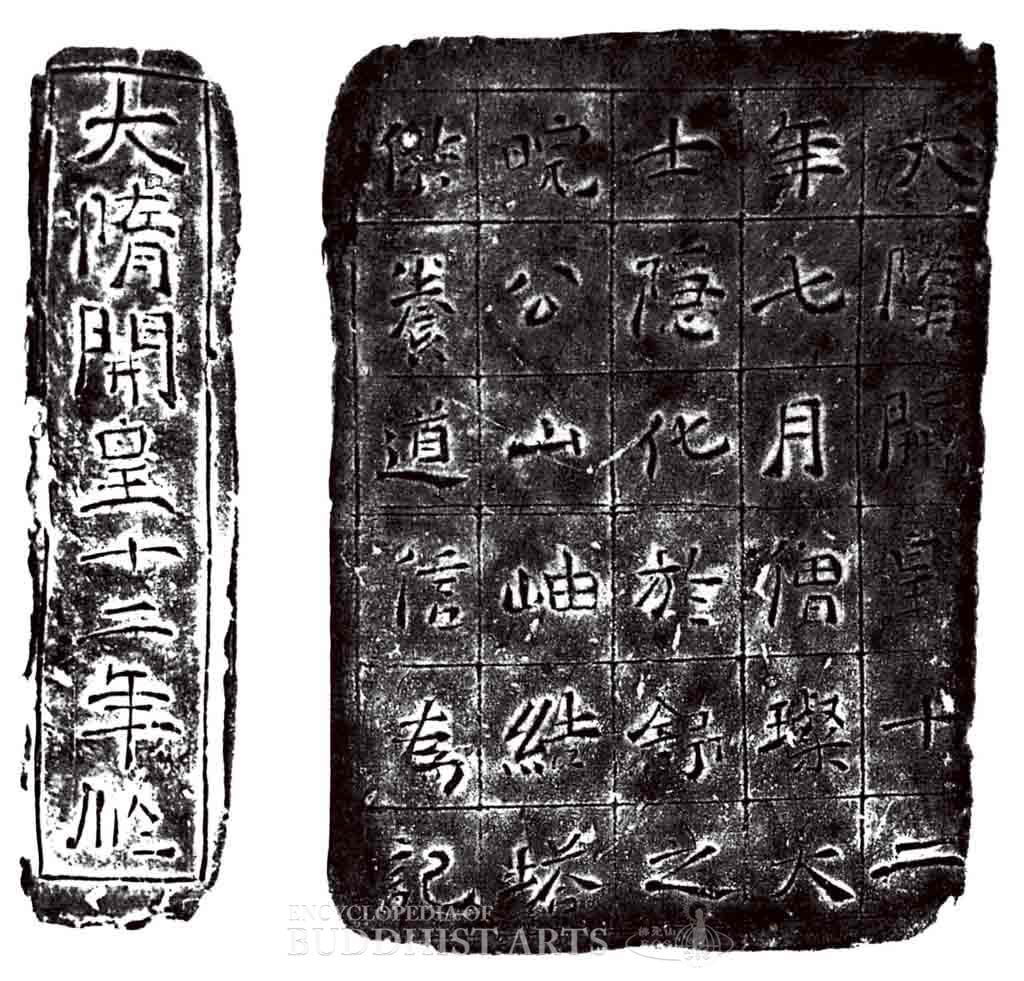
Hangzhou: Stele of the Brick Pagoda of Master Sengcan
Rubbing
Hangzhou: Stele of the Brick Pagoda of Master Sengcan
CHINA, Zhejiang, Hangzhou; Sui dynasty
This stele was unearthed in Hangzhou, Zhejiang in 1982. The epigraph states that in 592 of the Sui dynasty, Master Sengcan, the Third Patriarch of the Chan school, went into reclusion in a cave on Wangongshan of Shuzhou (present day Anhui). A pagoda was erected for veneration, and the inscription was recorded by his disciple, Daoxin. A postscript on the right side of the stele reads, “Made on the 12th year of the Sui dynasty.” This inscription revealed that during the persecution of Buddhism under the rule of Emperor Wu (reigned 561–578) of the Northern Zhou dynasty, Sengcan went into hiding at Wangongshan. It further denotes that Master Daoxin, the Fourth Patriarch, visited from afar in order to seek his guidance on the Dharma. Historical records on the life events of Master Sengcan are scant. His written work, Inscription on Faith in Mind, is regarded as a major influence on the development of Chan thinking.
Despite its short time span, the Sui dynasty (581–618) was a transitional period which served as a catalyst for the seamless integration of the Northern and Southern styles of calligraphy. Both the streamlined elegance of the South, and the bold simplicity of the North began to expand towards a regulated order, evolving into what is now known as the Tang regular script. Each character was placed in a grid-lined frame and was composed in lean, albeit strong and energetic brushstrokes. Configured within a spacious, uncluttered structure, the characters exude an inherited Northern stele style, featuring a tamed and refined disposition.
For more details, go to the Encyclopedia of Buddhist Arts: Calligraphy, page 87.
Cite this article:
author = Hsingyun and Youheng and Youlu and Pokorski, Stefanie and Mankuang and Edson, Gary,
booktitle = {Encyclopedia of Buddhist Arts: Calligraphy },
pages = 87,
title = {{Hangzhou: Stele of the Brick Pagoda of Master Sengcan}},
volume = 17,
year = {2016}}