
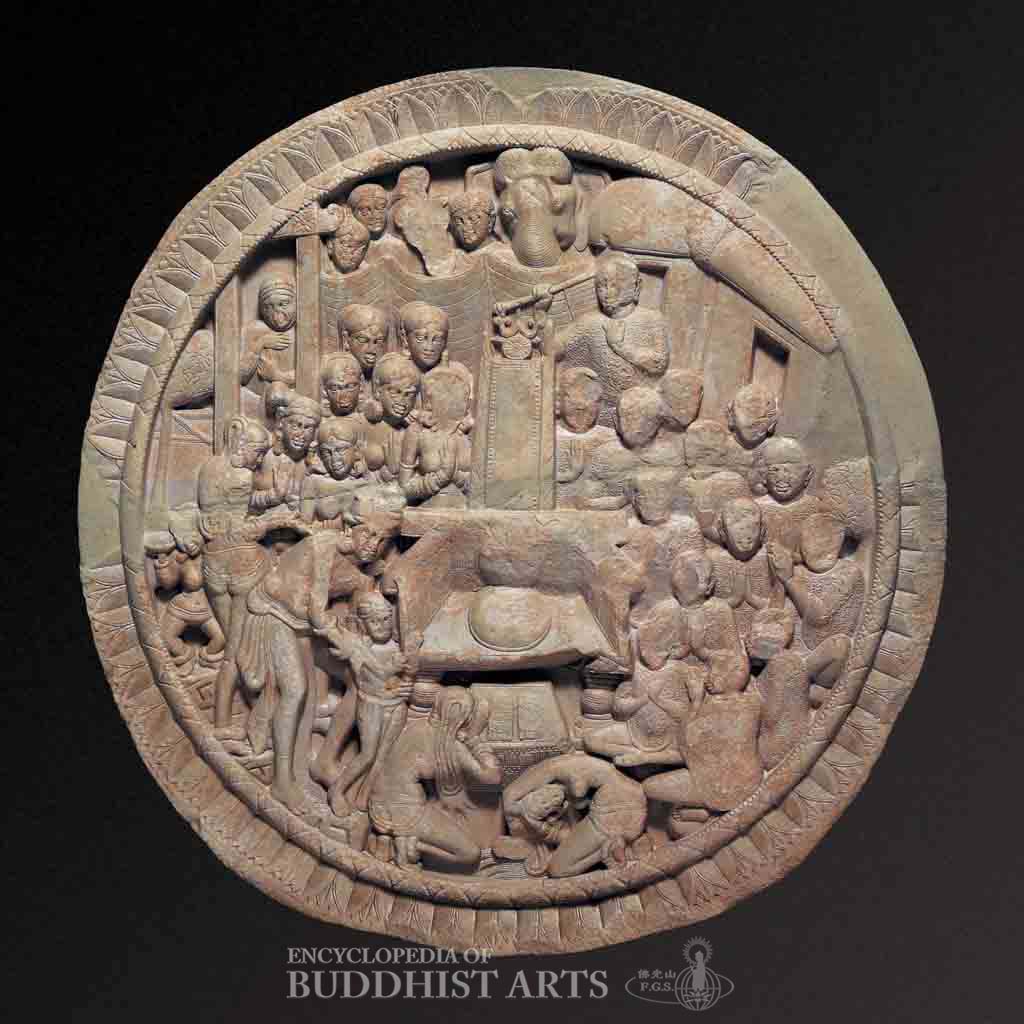
Amaravati: Paying Respect to the Buddha’s Footprints
Limestone
Amaravati: Paying Respect to the Buddha’s Footprints
INDIA, Andhra Pradesh, Amaravati; Satavahana period
The medallion was initially located on the railings surrounding the Great Stupa at Amaravati. An obvious crack across the surface shows that it was repaired at some time. The relief depicts a group of people paying respect to the Buddha’s footprints in the center.
An empty throne is located in the center. The Dharma wheel, two fire pillars, and the triratna are on the back of the throne. A pair of footprints is present on the footstool before the throne to represent the Buddha. The artwork is believed to date from the Satavahana period (circa 200 BCE–250 CE), which was the height of the Amaravati area. The characters are noticeably softer and more natural, compared with the stiff Mathura style found in northern India.
For more details, go to the Encyclopedia of Buddhist Arts: Sculpture A-F, page 24.
Cite this article:
author = Hsingyun and Youheng and Lovelock, Yann and Chou, Yuan and Huntington, Susan and Edson, Gary and Neather, Robert,
booktitle = {Encyclopedia of Buddhist Arts: Sculpture A-F},
pages = 24,
title = {{Amaravati: Paying Respect to the Buddha’s Footprints}},
volume = 10,
year = {2016}}