
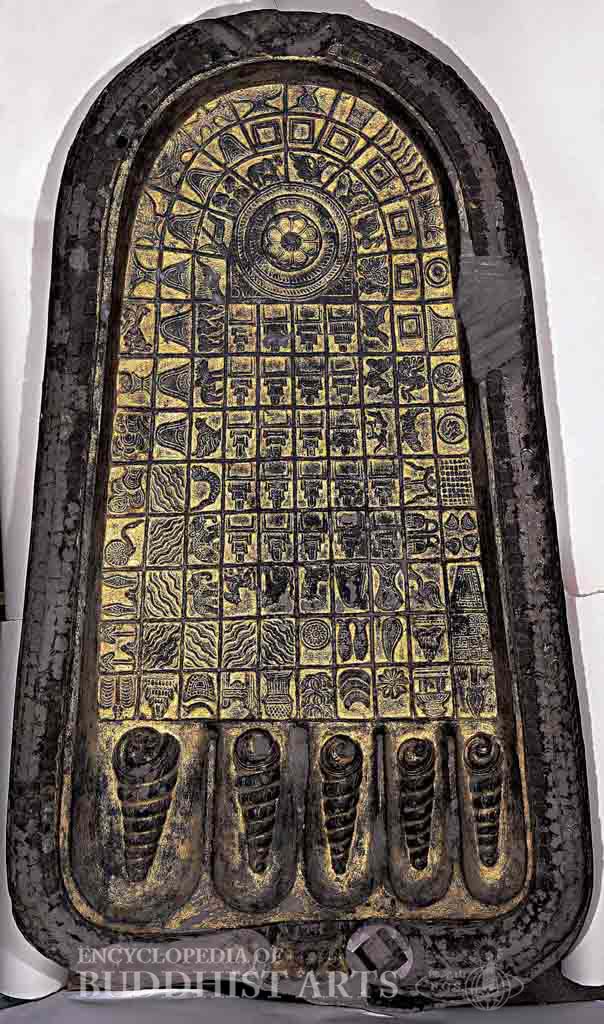
Yangon: Footprint of the Buddha
Stone with gold, glass and bitumen
Yangon: Footprint of the Buddha
MYANMAR, Yangon
Larger than an actual human foot, this rendition of a footprint is bordered by a naga that was originally inlaid with stained glass, while gold leaf has been applied to the body of the carving. The toes are of equal length, one of the Thirty-Two Marks of Excellence. They are decorated with a conch shell, which symbolizes the deep and joyful sound of the Dharma and is one of the eight auspicious symbols. Another auspicious symbol is the Dharma wheel. It has a lotus hub and is at the center of the heel, surrounded by 108 carved compartments that extend into the body of the foot. These contain architectural, animal, and other natural motifs.
For more details, go to the Encyclopedia of Buddhist Arts: Sculpture St-Z, page 1401.
Cite this article:
author = Hsingyun and Youheng and Lovelock, Yann and Chou, Yuan and Huntington, Susan and Edson, Gary and Neather, Robert,
booktitle = {Encyclopedia of Buddhist Arts: Sculpture St-Z},
pages = 1401,
title = {{Yangon: Footprint of the Buddha}},
volume = 13,
year = {2016}}