
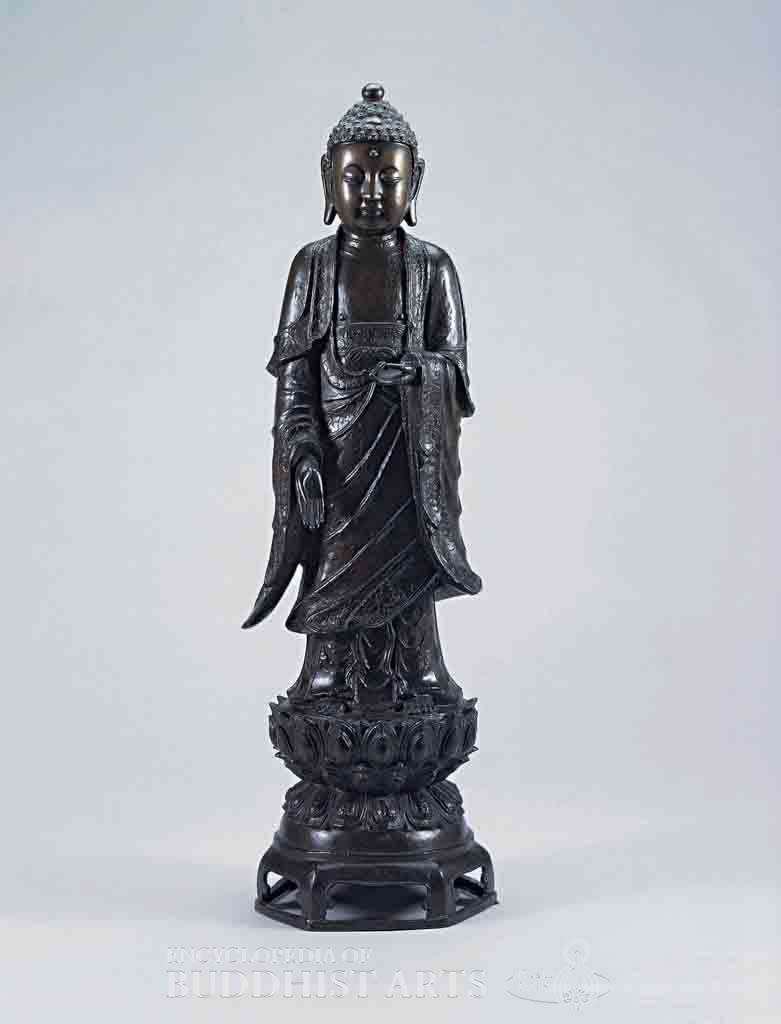
Amitabha Buddha
Gilt bronze
Amitabha Buddha
CHINA; Ming dynasty
The Buddha has tightly curled hair and a usnisa that rises to a jewel. An urna is located in the center of the forehead, while the eyes are downcast. The elongated ears and three lines on the neck are signs of a great person. Amitabha wears a loose, wide-girdled monastic robe with an embroidered hem. The right hand is lowered in the varada (wish-granting) mudra, and the left hand is held across the waist with palm facing upward. The figure stands on a double lotus pedestal that is supported by an openwork hexagonal stand. The inscription on the back of the stand states it was completed in 1612. Traces of the statue’s original gilding are still visible.
For more details, go to the Encyclopedia of Buddhist Arts: Sculpture A-F, page 30.
Cite this article:
author = Hsingyun and Youheng and Lovelock, Yann and Chou, Yuan and Huntington, Susan and Edson, Gary and Neather, Robert,
booktitle = {Encyclopedia of Buddhist Arts: Sculpture A-F},
pages = 30,
title = {{Amitabha Buddha}},
volume = 10,
year = {2016}}