
Seated Buddha
Bronze
Seated Buddha
INDIA
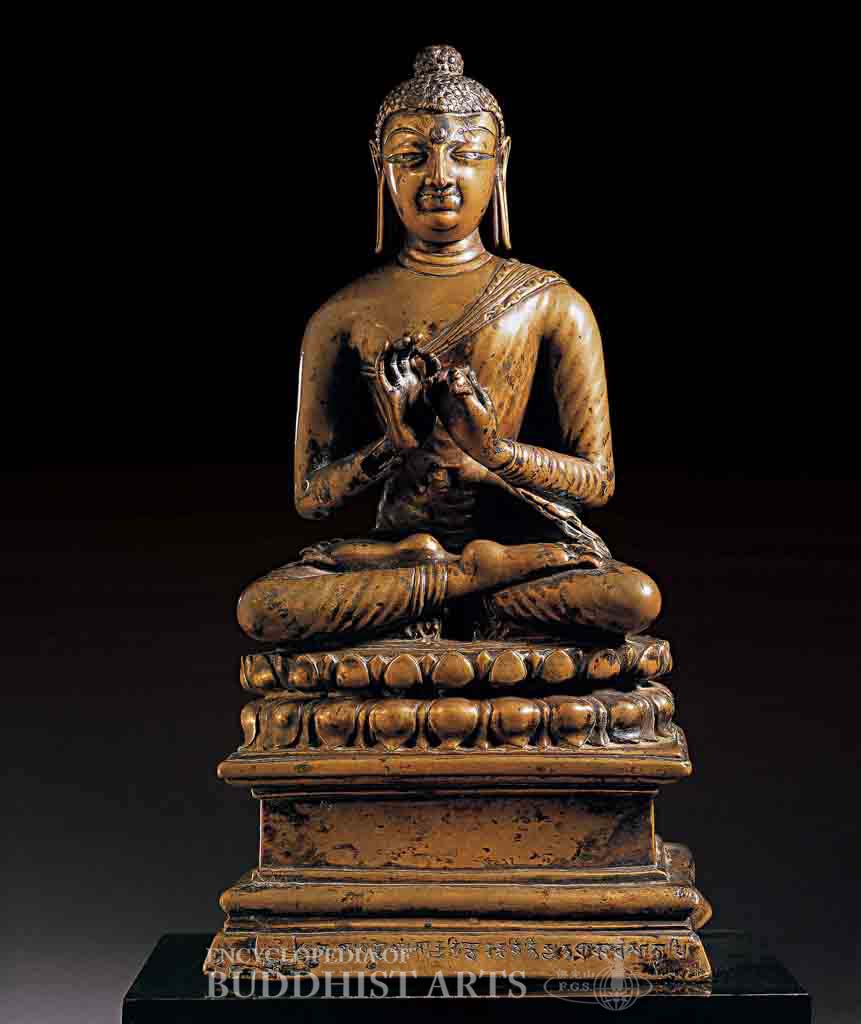
The facial features of this Buddha include those attributes of statues created during the Karkota period (circa 600–855) in Kashmir. Buddha characteristics consist of a high rounded usnisa, an urna, long earlobes and three lines on the neck. The eyes and urna have been inlaid with silver. A protruding tenon between the shoulders on the back suggests the statue originally had a nimbus.
The Buddha sits in full lotus position with hands in the Dharmacakra (Dharma wheel) mudra. The figure wears a monastic robe that leaves the right shoulder bare with folds delineated by faint lines. The double lotus throne rests on a rectangular Sumeru base, where an inscription states the statue was sponsored by the monk Ratnacittin circa 694 and dedicated to his parents, teachers, preceptors, and all sentient beings.
For more details, go to the Encyclopedia of Buddhist Arts: Sculpture N-Sr, page 1016.
Cite this article:
author = Hsingyun and Youheng and Lovelock, Yann and Chou, Yuan and Huntington, Susan and Edson, Gary and Neather, Robert,
booktitle = {Encyclopedia of Buddhist Arts: Sculpture N-Sr},
pages = 1016,
title = {{Seated Buddha}},
volume = 12,
year = {2016}}