
Ajanta Cave 7: Thousand Buddhas
Stone
Ajanta Cave 7: Thousand Buddhas
INDIA, Maharashtra, Aurangabad
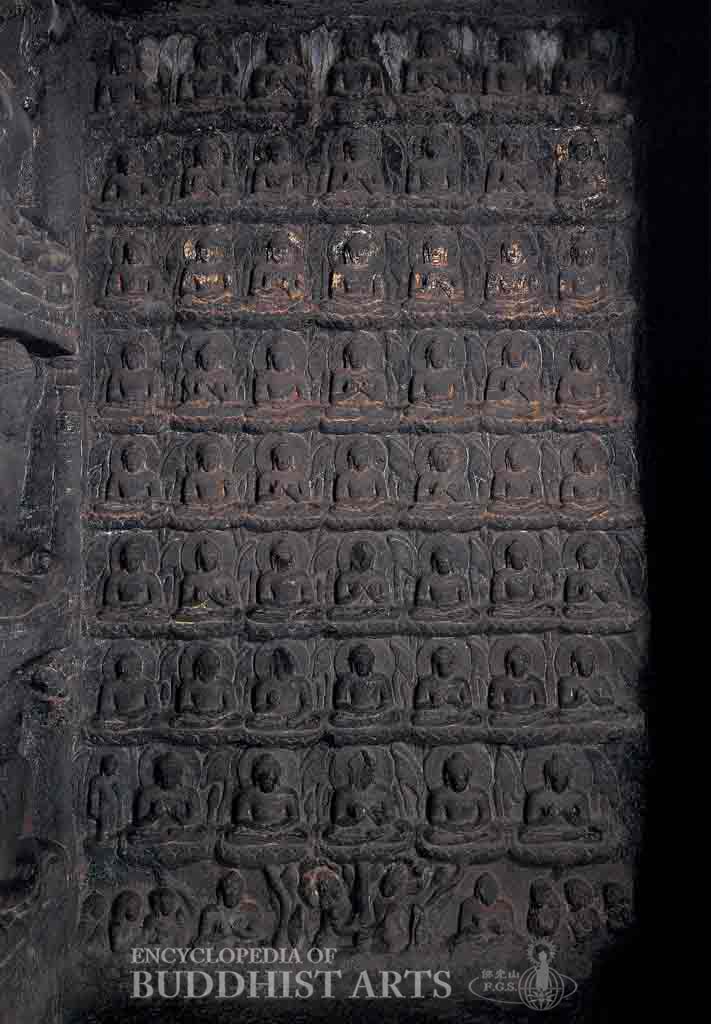
This relief mural is on the right wall of the antechamber. One of the most famous thematic representations in Buddhist art is the Thousand Buddhas. The imagery is drawn from the description of Sakyamuni Buddha’s demonstration of miraculous powers in the city of Sravasti. Among the occurrences was the creation of a vast array of Buddhas which appeared before the assembly and throughout the world.
The panel consists of nine rows. All but the last two have seven seated Buddhas, each forming the dhyana (meditation), vitarka (teaching), or abhaya (fearlessness) mudra. The second to last row contains a standing Buddha on the far left and five seated Buddhas. In the bottom row, a lotus stem is in the center, supported by two naga kings, and on either side, a seated Buddha is followed by three figures with palms joined. Traces of paint remain on the Buddhas, leaving a glimpse of the original colors that once endowed this marvelous work.
For more details, go to the Encyclopedia of Buddhist Arts: Caves A-E, page 32.
Cite this article:
author = Hsingyun and Youheng and Johnson, Peter and Mankuang and Huntington, Susan and Edson, Gary and Neather, Robert,
booktitle = {Encyclopedia of Buddhist Arts: Caves A-E},
pages = 32,
title = {{Ajanta Cave 7: Thousand Buddhas}},
volume = 5,
year = {2016}}