
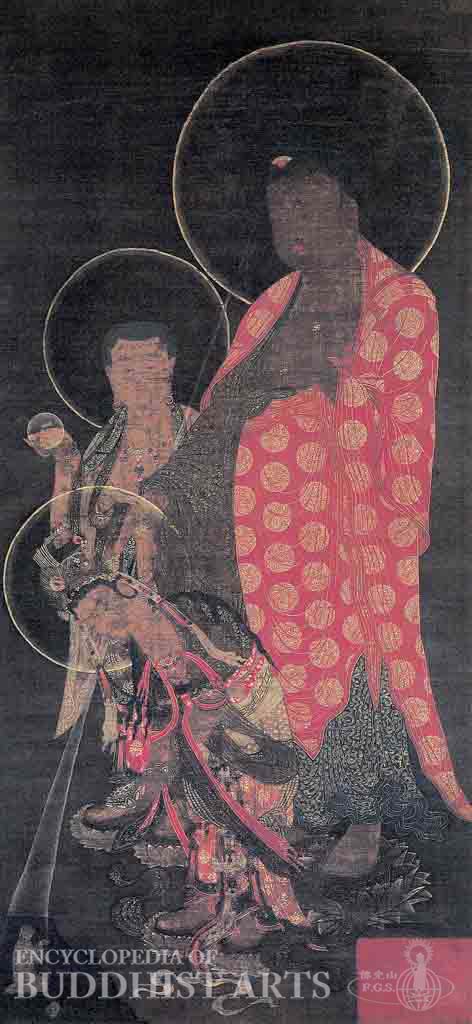
Amitabha Buddha Triad Welcoming the Deceased
Ink and color on silk
Amitabha Buddha Triad Welcoming the Deceased
KOREA; Goryeo dynasty
This painting is reputed to be the best example of Goryeo Buddhist paintings. In 1984, it was listed as National Treasure No. 218. Amitabha’s right palm is lowered and displays a thousand-spoked wheel. A ray of light extends from the urna to the bottom left, where a deceased being kneels with joined palms. Avalokitesvara bends forward and holds out a lotus throne for the being. This portrayal is similar to the Amitabha Buddha Triad painting discovered in Khara Khoto, Inner Mongolia, which suggests the influence of Buddhist paintings from the Western Xia period (1032–1227). In this painting, Mahasthamaprapta is replaced by Ksitigarbha Bodhisattva who stands holding a jewel and a monk’s staff.
For more details, go to the Encyclopedia of Buddhist Arts: Painting A-H, page 41.
Cite this article:
author = Hsingyun and Youheng and Youlu and Wilson, Graham and Manho and Mankuang and Huntington, Susan,
booktitle = {Encyclopedia of Buddhist Arts: Painting A-H},
pages = 41,
title = {{Amitabha Buddha Triad Welcoming the Deceased}},
volume = 14,
year = {2016}}