
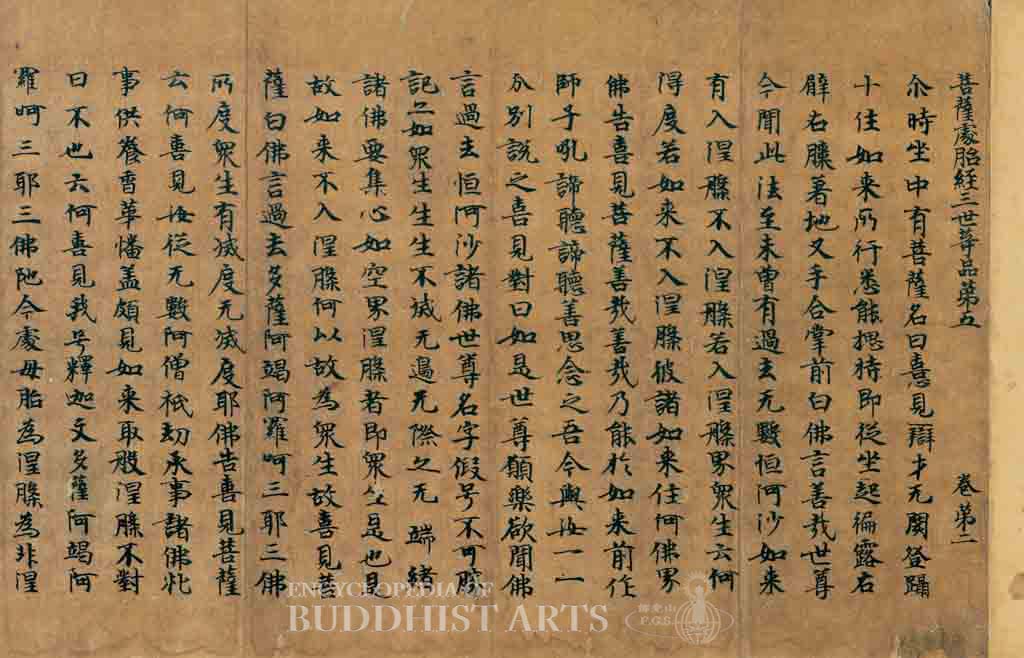
Bodhisattva in the Womb Sutra - Fascicle 2 (right end section)
Ink on paper
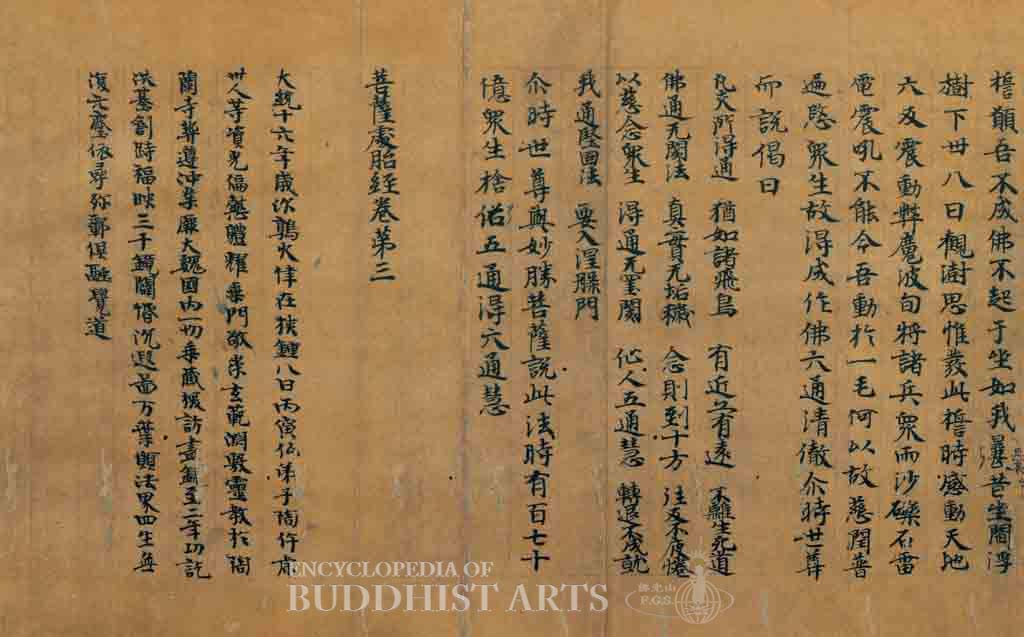
Bodhisattva in the Womb Sutra - Fascicle 3 (left end section)
Bodhisattva in the Womb Sutra
CHINA; Western Wei dynasty
This sutra copy, which was originally a long scroll, was preserved as an accordion-fold book with each page measuring 23.9 cm high by 9.1 cm wide. The entire work consists of two major parts: a manuscript of the Bodhisattva in the Womb Sutra, copied during the rule of Emperor Wen (reigned 535–551), and an ancient Japanese sutra manuscript.
This copy of the Bodhisattva in the Womb Sutra was one of the manuscripts compiled. Based on the postscripts and imprints on the piece, it is evident that the work was part of a compilation from the Western Wei dynasty (535–556) in which sutras from all over China were copied in the year 550. The sutra was later brought to Japan, but it faced the Bakumatsu years of the Edo period (1615–1868), in which the abolishment of Buddhism took place. Concerned that the sutra may be destroyed, a Japanese monk named Ukai Tetsujo mounted an ancient Japanese sutra manuscript onto its back to ensure its survival through the hostile period. The result is a single artifact layered with sutra manuscripts from two different periods. This is a rare example since each piece represents two separate efforts to preserve Buddhist sutras from different periods in history. The manuscript was listed as a National Treasure of Japan in 1952.
This piece was likely the first copy of the Bodhisattva in the Womb Sutra to be circulated publicly. Its regular script is well-preserved, and signs of influence from clerical script are evident as well. The characteristic lateral swaying of clerical writing is seen in several examples. There are, for instance, characters that are somewhat square or rectangular in frame, which carry long horizontal strokes that slightly bow. The right-falling horizontal strokes are broadly executed without transitional segments or turns. Nevertheless, the articulations of each stroke were significantly matured, such that the composition of the clerical style dynamically complements the rich variety of regular script.
For more details, go to the Encyclopedia of Buddhist Arts: Calligraphy, page 20.
Cite this article:
author = Hsingyun and Youheng and Youlu and Pokorski, Stefanie and Mankuang and Edson, Gary,
booktitle = {Encyclopedia of Buddhist Arts: Calligraphy },
pages = 20,
title = {{Bodhisattva in the Womb Sutra}},
volume = 17,
year = {2016}}