
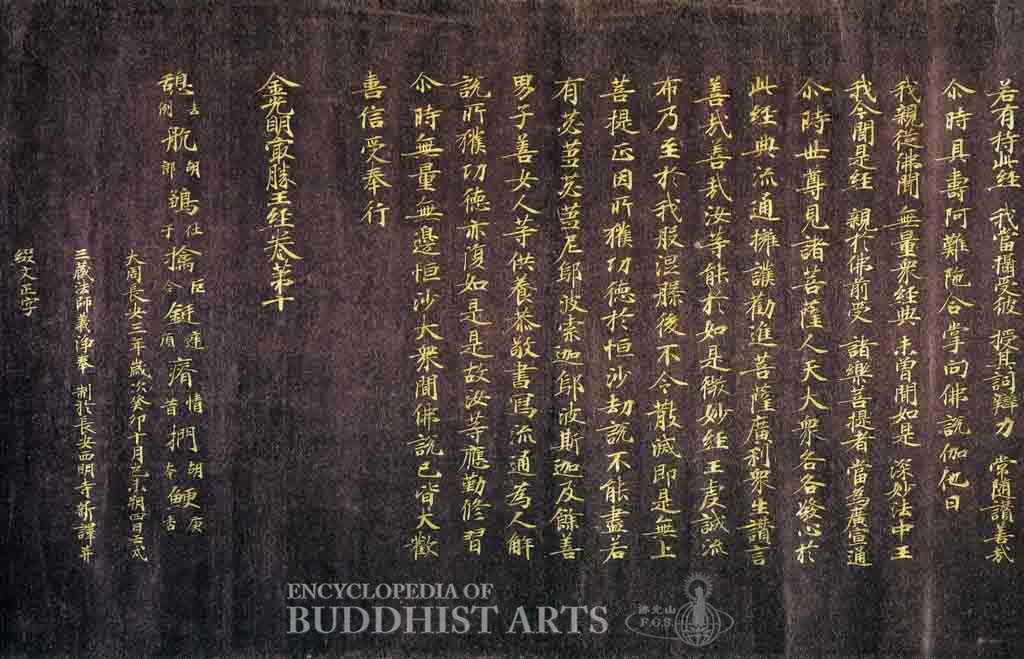
Golden Light Sutra - Fascicle 10 (left end section)
Gold on paper
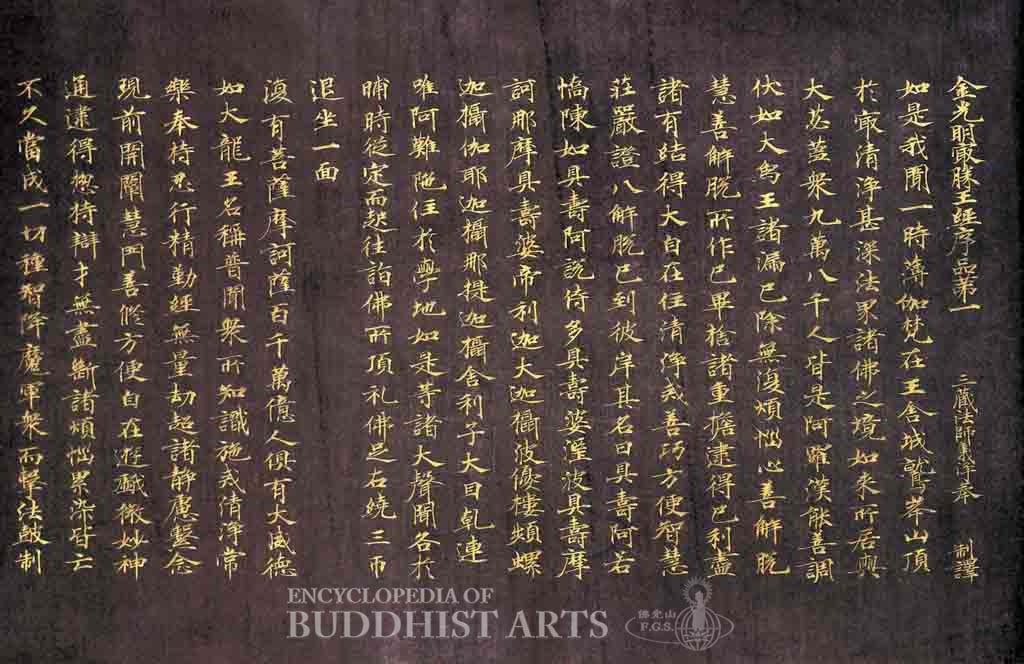
Golden Light Sutra - Fascicle 1 (right end section)
Golden Light Sutra
JAPAN; Nara period
During the rule of Emperor Shomu (reigned 724–749) of the Nara period, the construction of provincial temples called “Kokubunji” was ordered across the country. Each of these temples were required to enshrine a copy of the Golden Light Sutra, and thus the sutra was also known as the Kokubunji Temple Sutra. The Todaiji Temple Shosoin in Nara contains a similar work, in which the top of the scroll is embroidered with an inscription that records the housing of a Golden Light Sutra in every province as decreed in 742. This piece was therefore considered to be produced under similar circumstances, and it was listed as a National Treasure in 1952.
Given that gold ink is more difficult to apply than the typically used black ink due to its more coagulated consistency, the lucid and fluent style in which the characters were written on this particular scroll suggests a mastery of the medium. The turns, bends, and falling sweeps are forceful and direct, which add a layer of strength and vitality to the already refined calligraphy.
For more details, go to the Encyclopedia of Buddhist Arts: Calligraphy, page 83.
Cite this article:
author = Hsingyun and Youheng and Youlu and Pokorski, Stefanie and Mankuang and Edson, Gary,
booktitle = {Encyclopedia of Buddhist Arts: Calligraphy },
pages = 83,
title = {{Golden Light Sutra}},
volume = 17,
year = {2016}}